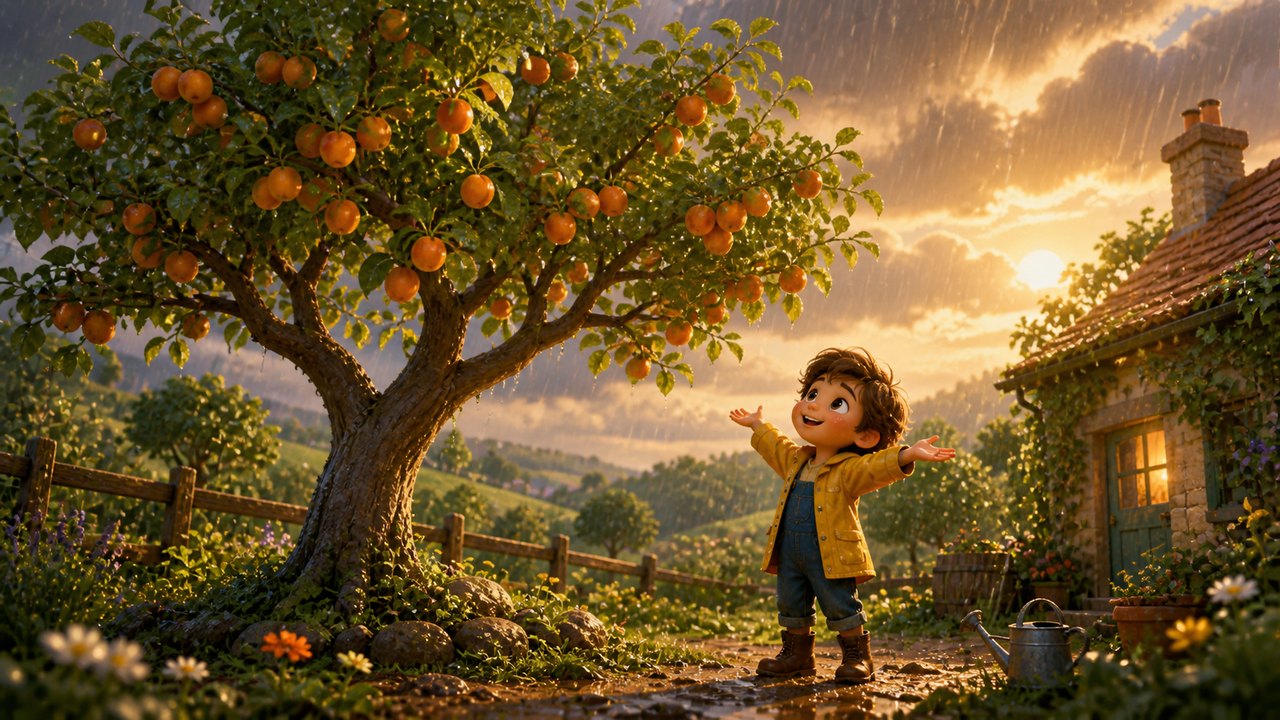
How long can you hold on when everything tells you to let go?
In the village of Kadem, at the edge of the great southern plain, there once stood an orchard of forty trees. Plum and pear, apple and fig, and one apricot—the smallest of them all, planted last, growing in the shadow of her older sisters. Her name, if trees have names (and in this story they do), was Safa.
Safa was not remarkable. Her trunk was thin. Her branches did not spread as wide as the plum's. Her fruit, when it came, was small and sometimes sour. The villagers picked from her last, if they picked from her at all. She did not mind. She was patient. She was alive. That was enough.
Then came the drought.
It began in April, when the spring rains simply did not arrive. The sky stayed white and empty. The earth cracked. The river that fed the orchard's irrigation channel thinned to a trickle, then a damp line in the dust, then nothing at all. By June, the grass between the trees was brown and brittle as old paper.
"This will pass," said the old plum tree, whose roots went deep. "Droughts always pass."
But this one didn't. July came dry. August came drier. September brought no relief—only hot wind that pulled moisture from leaves like a thief pulling coins from a pocket. One by one, the trees began to fail.
The pear trees went first. They were shallow-rooted and elegant, and elegance does not survive drought. Their leaves curled brown and fell. Their branches went brittle. By October, they stood like skeletons.
The apple trees held longer—they were sturdier, more stubborn. But stubbornness without water is just slow dying. By December, they too had shed their leaves and gone silent.
The old plum, with her deep roots, lasted until February. But even deep roots find nothing when the water table drops below stone. One morning, the villagers heard a sound like a long sigh, and the plum's great central branch cracked and fell to earth. She was done.
Only Safa remained.
She should not have survived. She was the smallest. The youngest. The least impressive tree in the orchard. But Safa had something the others did not: she had learned, in her years of growing in shadow, to need very little. Her roots were not deep like the plum's—they spread wide, threading sideways through the shallow soil, catching every trace of moisture that condensed at night. Her leaves were small, losing less water to the sun. Her trunk was thin, demanding less to sustain.
She was built for hardship. She just hadn't known it until hardship came.
Still, it was not easy. There were nights when Safa felt her branches lighten—sap retreating, cells closing down, the slow withdrawal of life conserving itself. She dropped her leaves deliberately, one by one, saving energy. She pulled into herself like a fist.
"Why bother?" whispered the wind, who had no stake in anything. "The others have given up. You're alone. No one is watching. No one would blame you for stopping."
Safa did not answer the wind. She did not argue with despair—she simply refused it. Not loudly. Not heroically. Just quietly, in the way that roots refuse to stop reaching even when there is nothing to reach for.
March came. Then April again. A full year without rain. Safa was a skeleton of herself—bare branches, cracked bark, a shape that looked more dead than alive. The villagers walked past her without looking. Some had already begun cutting the dead trees for firewood. A man with an axe stopped at Safa's base, considered, then shook his head.
"Too thin," he said. "Not worth the swing."
Even that was a kind of mercy.
The rain came on a Tuesday in May—thirteen months after it had left. It did not announce itself. There was no dramatic thunderclap, no wall of cloud marching across the sky. It simply began: a soft, persistent drizzle that darkened the dust and made the cracked earth hiss.
Safa felt it. Every root, every fibre, every dormant cell. The water soaked into the soil like breath into lungs that had forgotten how to breathe. She drank. Slowly at first, carefully, the way a starving creature eats—small sips, not gulps. Her roots swelled. Her bark softened. Deep inside her trunk, sap began to move.
Three days later, a bud appeared. Small. Pink. Impossibly delicate on a branch that had looked dead for months.
Then another. And another.
Within a week, Safa was covered in blossoms. Not many—she was still weak, still recovering—but enough. Enough to be seen from the village. Enough to make a child point and say, "Look! The little tree is flowering!"
The villagers came. They stood beneath Safa's branches and looked up at the pale pink blooms against the grey May sky, and several of them wept. Not because a tree was flowering—trees flower every year. But because this tree had flowered. This tree that had every reason to die and didn't. This tree that held on through thirteen months of nothing, on the bare faith that rain would come eventually.
They did not cut the dead orchard for firewood after all. Instead, they planted new saplings between the old stumps—apricot saplings, all of them, grown from Safa's seeds. Because if any tree had earned the right to mother a new orchard, it was the one that refused to let go.
Years later, the orchard of Kadem was famous across the plain. Forty apricot trees, all daughters of Safa, all built lean and wide-rooted, all made for hardship. And in the centre, older and thicker now but still smaller than you'd expect, stood Safa herself—blooming every spring without fail, as if to say:
I waited. And it was worth it. It was always going to be worth it.