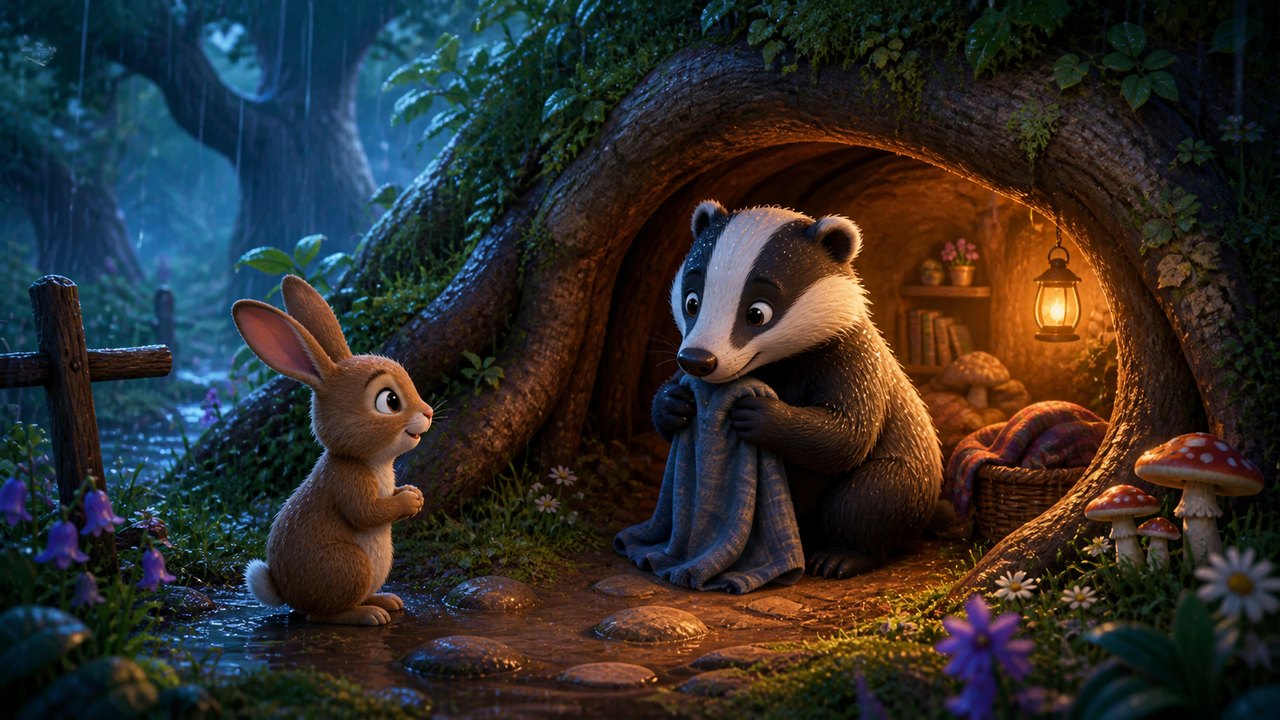
The burrow was perfect. That was the problem.
Bramble had been wandering the Ashwood for three days—wet, hungry, and too proud to admit he was lost—when he stumbled upon it. A wide entrance beneath an oak root, swept clean of leaves, with smooth walls that curved inward like cupped hands. Inside: a dry sleeping chamber lined with moss, a pantry alcove stocked with acorns and dried mushrooms, and a back tunnel that opened onto a hidden stream for drinking water.
It was, without question, the finest burrow Bramble had ever seen. And it was empty.
He told himself he would stay just one night. Just until the rain stopped and he could find his way back to his own territory on the far side of the ridge. One night became two. Two became a week. The burrow was warm. The pantry was full. The stream ran sweet and cold. And slowly, without quite deciding to, Bramble stopped thinking of it as someone else's home and started thinking of it as his own.
When the squirrel Nutkin asked who had dug such a splendid burrow, Bramble puffed out his chest. "I did, naturally. Took me all autumn."
"Really?" Nutkin's nose twitched. "The digging marks look like rabbit work to me. The angle, the width—"
"What do squirrels know about digging?" Bramble snapped. "Stick to your trees."
Nutkin left, unconvinced. But no one challenged Bramble further. He was large. He was loud. And he was a badger, which in the Ashwood carried a certain authority that smaller creatures did not question to his face.
Weeks passed. Bramble ate the stores in the pantry without replacing them. He tracked mud through the sleeping chamber. He let leaves pile up at the entrance until the once-tidy burrow looked like any other hole in the ground—lived in but not loved.
Then, on the first warm morning of March, Bramble woke to the sound of humming.
It was coming from the entrance tunnel. A low, rhythmic humming—the kind a creature makes when it's coming home after a long journey and can already smell familiar earth. Bramble's blood went cold.
A rabbit appeared in the tunnel mouth. She was brown and lean, with one ear torn short—an old scar, long healed—and she carried a bundle of dried lavender in her teeth. She stopped when she saw Bramble.
They stared at each other.
"Well," said the rabbit. She set the lavender down carefully. "You've made yourself comfortable."
Bramble's mouth opened and closed. He wanted to bluster—this is my burrow, I dug it, get out—but the words dissolved on his tongue. Because the rabbit was looking at the walls. At the precise, even claw marks. At the dimensions of the tunnel, exactly wide enough for a rabbit and slightly too narrow for a badger, which was why Bramble had to turn sideways every time he entered.
"I'm Moss," said the rabbit. "And this is my home. I dug it four springs ago, before my journey south. I left stores in the pantry for my return." She glanced at the empty alcove. "I see those are gone."
"I—" Bramble began. "I was only—"
"You were only what?" Moss's voice was not angry. It was worse than angry. It was calm. Patient. The voice of someone who knows the truth and is simply waiting for the other to catch up to it.
Bramble sat down heavily. The sleeping chamber felt very small suddenly. "I was lost," he admitted. The words came out rough, like stones pulled from mud. "I found this place empty and I—I needed somewhere. And then I stayed. And then I pretended it was mine because—"
He stopped. Why had he pretended? What was the real reason underneath the bluster?
"Because asking for help felt worse than lying," Moss finished for him. She said it gently. She had known creatures like Bramble before—big on the outside, hollow with pride on the inside.
"Yes," Bramble whispered. "Because asking for help felt like being small."
Moss sat down across from him. She was half his size. Her torn ear caught the light from the entrance tunnel. She did not look small at all.
"Bramble," she said. "If you had knocked on any burrow in this wood and said 'I am lost and I need shelter,' do you know what would have happened?"
He shook his head.
"Someone would have let you in. Fed you. Helped you find your way home. That's what we do here." She gestured at the burrow walls. "I didn't build this alone—the moles helped me with the back tunnel. Nutkin brought the acorns for the pantry. The wrens lined the sleeping chamber with moss they gathered from the north stones." She smiled. "This burrow belongs to me, but it was built by a community. Because I asked."
Bramble felt something crack inside his chest. Not break—crack open. Like a seed splitting its hull.
"I'm sorry," he said. "For eating your stores. For muddying your floors. For telling everyone I built this place." He paused. "For not just asking."
Moss nodded. "You can stay tonight. Tomorrow, I'll help you dig your own burrow. It won't be as fine as this one—not at first. But it'll be yours. Truly yours."
"I don't know how to dig a proper burrow," Bramble admitted. It was the hardest sentence he had ever spoken.
"Then I'll teach you," said Moss. "That's not shameful, Bramble. That's just how the world works. Everyone learns from someone."
They dug together the next day—Bramble with his powerful claws, Moss with her architect's eye for angles and drainage. By sunset, Bramble had a burrow. Small. Simple. Slightly crooked in the back tunnel. But his. Every inch of earth moved by his own hands, guided by someone who knew better and was kind enough to show him.
He never claimed another creature's work again. And every spring, when he heard the humming of Moss returning from her winter journey south, he left a bundle of dried mushrooms at her door—his own harvest, honestly gathered, freely given.
It was the smallest gift in the Ashwood. And the truest.