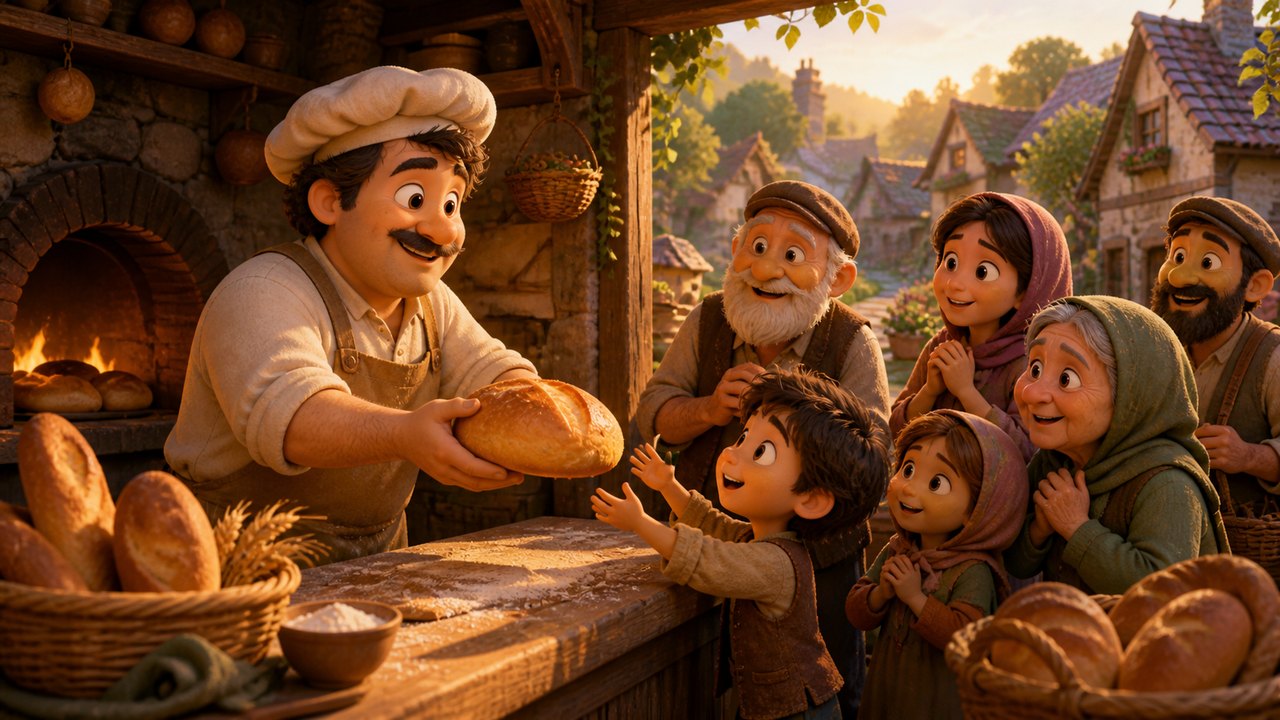
"One loaf," Matteo said to himself, wiping his hands on his apron. "One loaf, and the day is done."
It sat on the counter like a small sun — round, golden-crusted, still breathing warmth into the cooling air of the shop. Matteo had been baking since three in the morning, as he had every morning for forty-one years, and this was the last of sixty loaves. The rest had gone to their homes: to the schoolteacher's table, to the tailor's lunch pail, to the priest's rectory where Father Dominic ate his bread with nothing but olive oil and silence.
The bell above the door rang. Two people entered at the same moment, so close together that their shoulders nearly touched in the narrow doorway.
The first was a woman Matteo did not recognize. She was thin in the way that speaks not of fashion but of missed meals — her coat too large, her wrists sharp beneath the cuffs. She carried a small child on her hip, a boy of perhaps two, who stared at the loaf with enormous, unblinking eyes.
The second was Signora Marchetti, wife of the cloth merchant, who wore her prosperity like perfume. Her coin purse was already in her hand.
"Matteo!" Signora Marchetti said brightly. "Thank heaven you still have one left. I need it for tonight — my husband's brother is visiting from Torino, and you know how he is about fresh bread."
The stranger said nothing. She simply stood, one hand on her child's back, looking at the loaf the way a sailor looks at shore.
Matteo felt the weight of the moment settle on him like flour dust. He looked at the loaf. He looked at the two women. The child on the stranger's hip made a small sound — not quite a word, not quite a cry, something in between that meant hungry in any language.
"Signora Marchetti," Matteo said carefully, "you are a loyal customer."
"Twenty years," she confirmed, setting two coins on the counter with a decisive click.
"And you, signora?" he said to the stranger. "What brings you here?"
The woman's jaw tightened. Pride fought with need across her face. "We've been walking since yesterday," she said quietly. "From Castellina. My husband's work there ended. We're going to my sister in Firenze." She paused. "I have no money. I only stopped because the boy—" She looked at her son. "He hasn't eaten since morning."
Signora Marchetti shifted uncomfortably. "Matteo, surely you can see that I was here to buy. She's asking for charity. That's — well, it's different, isn't it? I can come back tomorrow if you like, but tonight I need this bread."
Matteo picked up the loaf. It was warm and solid in his hands — a perfect thing, if bread can be perfect. He thought about what his wife, God rest her, would have said. He thought about what his father, who had built this bakery with borrowed money and calloused hands, would have done.
Then he took his bread knife from beneath the counter.
"What are you doing?" Signora Marchetti asked.
Matteo cut the loaf in two. Not perfectly in half — one piece was slightly larger. He wrapped the larger piece in brown paper and held it out to the stranger.
"For the road to Firenze," he said.
The woman's eyes filled. She took the bread and broke a piece immediately for her son, who grabbed it in both fists and ate with the focus of the very young and very hungry.
"Thank you," she whispered. "I'll remember this. I'll remember your name."
"It's just bread," Matteo said, though they both knew it wasn't.
He turned to Signora Marchetti and offered her the remaining half. Her face was a complicated landscape — annoyance and shame and something softer fighting for territory.
"Half a loaf," she said flatly. "For the full price?"
"No," Matteo said. "For half the price. One coin."
She stared at him. Then she pushed both coins across the counter. "Keep the full price," she said, her voice odd and tight. She took the bread, turned toward the door, then stopped.
"You." She was looking at the stranger. "How far is it to Firenze?"
"Two days' walk, signora."
Signora Marchetti opened her coin purse again. She removed a handful of coins — not a fortune, but enough — and pressed them into the woman's free hand.
"There's an inn at the crossroads past San Donato," she said brusquely, not meeting the woman's eyes. "The beds are clean and the soup is decent. Tell them Rosa Marchetti sent you. They know me there."
Then she was gone, the bell singing behind her.
The stranger looked at the coins in her palm, then at Matteo. "Did you know she would do that?"
"No," Matteo admitted. He smiled. "But I hoped."
The woman shifted her son to her other hip. The boy was already drowsy, his cheeks flushed with the warmth of bread and safety. "What if she hadn't? What if she'd just been angry and left?"
Matteo considered this. He took off his apron and folded it with the care of a man finishing his day's work. "Then you would still have bread," he said. "And she would still have half. And I would close my shop knowing that nobody walked away from my door hungry." He hung the apron on its hook. "That would have been enough."
The woman thanked him once more and left, her son already sleeping against her shoulder, one small fist still clutching a crust of bread.
Matteo locked the door, turned the sign to CLOSED, and swept the flour from his floor. The shop was empty now — no bread, no customers, no coins beyond what he needed. Just the smell of what he'd made, lingering like a blessing in the cooling air.