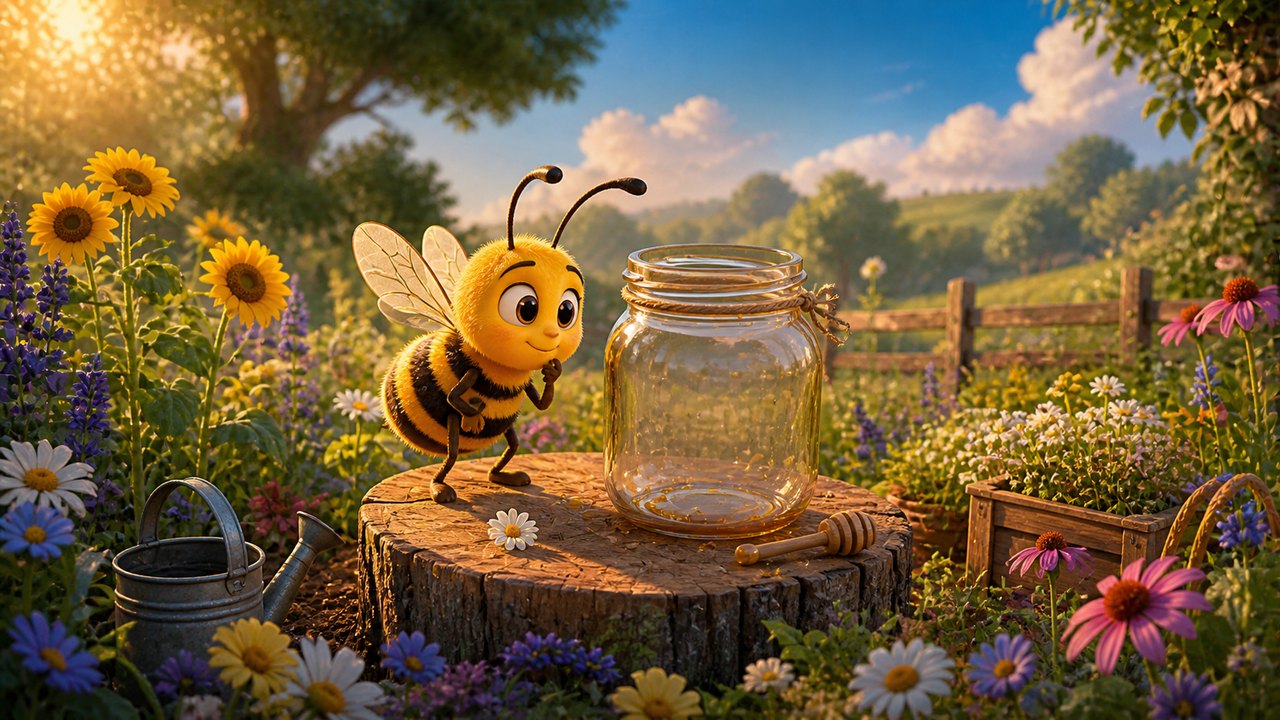
It started with a single drop.
Goldie was returning from the clover field — mouth full of nectar, legs dusty with pollen — when she noticed a crack in the old stone wall near the hive. Behind the crack: a space. Dry, hidden, perfectly sized for one bee and whatever she might want to keep there.
She didn't plan it. Not at first. She simply deposited a drop of honey in the crack — a snack for later, nothing more. But the space called to her. Its emptiness felt like potential. Like safety. Like mine.
Within a week, she'd found a jar. An old thimble, really, dropped by some child years ago — silver-sided, deep enough to hold a season's worth of honey if she was disciplined. And Goldie was nothing if not disciplined.
Every day, while her sisters flew their nectar to the communal comb, Goldie skimmed a portion for herself. Not much. Just a smear. Just enough that no one would notice. The thimble filled slowly, golden and thick, glowing in the dim crack like a tiny captured sun.
"Goldie, you seem tired lately," said her sister Clover one afternoon, landing beside her on a sunflower. "You're working more hours than anyone."
"I just like to be thorough," Goldie said, avoiding Clover's eyes.
"You know you don't have to do extra, right? The hive has plenty. We always take care of each other."
"I know," Goldie said. But she thought: what if you don't? What if one winter there isn't enough? What if the hive fails and I'm left with nothing?
She'd seen it happen. Two years ago, the Blackthorne hive across the meadow had collapsed — disease, then starvation. Goldie remembered the refugees arriving at their door, thin and desperate. The queen had taken them in, of course. Shared everything. But Goldie had watched those hollow-eyed bees and thought: never me. I will never be that vulnerable.
So she hoarded. All summer and into fall, while her sisters danced and sang and built their comb together, Goldie skimmed and saved and visited her secret crack in the wall.
"You've been distant," said Fern, her oldest friend, one October evening. The hive was warm with communal heat — three thousand bodies vibrating gently, sharing warmth against the coming cold. "You missed the harvest dance. And the queen's address. And last week you didn't come to the nursery when the new larvae hatched."
"I've been busy."
"Busy with what? The flowers are almost gone. There's nothing left to gather."
"Personal projects," Goldie said vaguely.
Fern looked at her for a long time. "Goldie. You know that when winter comes, we survive by staying together. Literally. Our bodies — the cluster, the vibration — that's what keeps us alive. No bee survives alone."
"I know that," Goldie said. She knew it intellectually. But her jar was full now — beautiful and golden and hers — and the pride of it outweighed the warning.
November came like a closing door. The hive sealed itself. Three thousand bees pressed together in the dark, vibrating their wing muscles to generate heat, rotating from the cold outer edges to the warm center in an ancient, wordless democracy of survival.
Goldie was not among them.
She was in her crack in the wall. Her jar beside her, full to the brim. She had everything she needed — food for months. Security. Independence.
What she did not have was warmth.
The first night was uncomfortable. The second was painful. By the third, Goldie could barely move her wings. A single bee generates almost no heat alone. The temperature inside her crack dropped and kept dropping. She ate honey — her beautiful, hard-won honey — but it couldn't warm her. Calories without community are just sugar. Energy with nowhere to go.
On the fourth night, half-frozen and finally afraid, Goldie dragged herself out of the crack and across the cold stone to the hive entrance. She was too stiff to fly. She crawled.
The guard bees found her at the door, barely conscious, wings rigid with cold.
"Goldie?" It was Clover's voice. "Goldie! Where have you been? We've been worried sick—"
They pulled her inside. Into the cluster. Into the warmth. Three thousand bodies shifted to make room for one more, and the heat was immediate and overwhelming — the warmth of being held by everyone at once.
Goldie wept. Bees can't really weep, but she did something that felt like it — a shuddering, a releasing, a letting go of the thing she'd been gripping so tightly.
"I have honey," she said, when she could speak again. "In the wall. A whole jar. I was saving it. In case—"
"In case we failed you?" Fern asked. Not angry. Sad.
"Yes."
"And did we?"
Goldie looked around at the cluster — at Clover and Fern and hundreds of sisters she knew by scent and sound, all of them vibrating their warmth into the shared air, all of them alive because none of them was alone.
"No," she said. "I failed you. I kept something for myself instead of trusting that together we'd have enough."
In the spring, when the first crocuses opened and the bees spilled out into the light, Goldie led Fern and Clover to the crack in the wall. The jar was still there, the honey crystallized but intact.
"Should we bring it back to the hive?" Clover asked.
"Yes," Goldie said. "All of it."
She never filled the jar again. She didn't need to. What she needed — what she'd always needed — wasn't stored in silver thimbles or hidden in cracks. It was in the hum of three thousand wings beating together against the cold.
And that, she finally understood, was something you could only have by giving yourself to it completely.