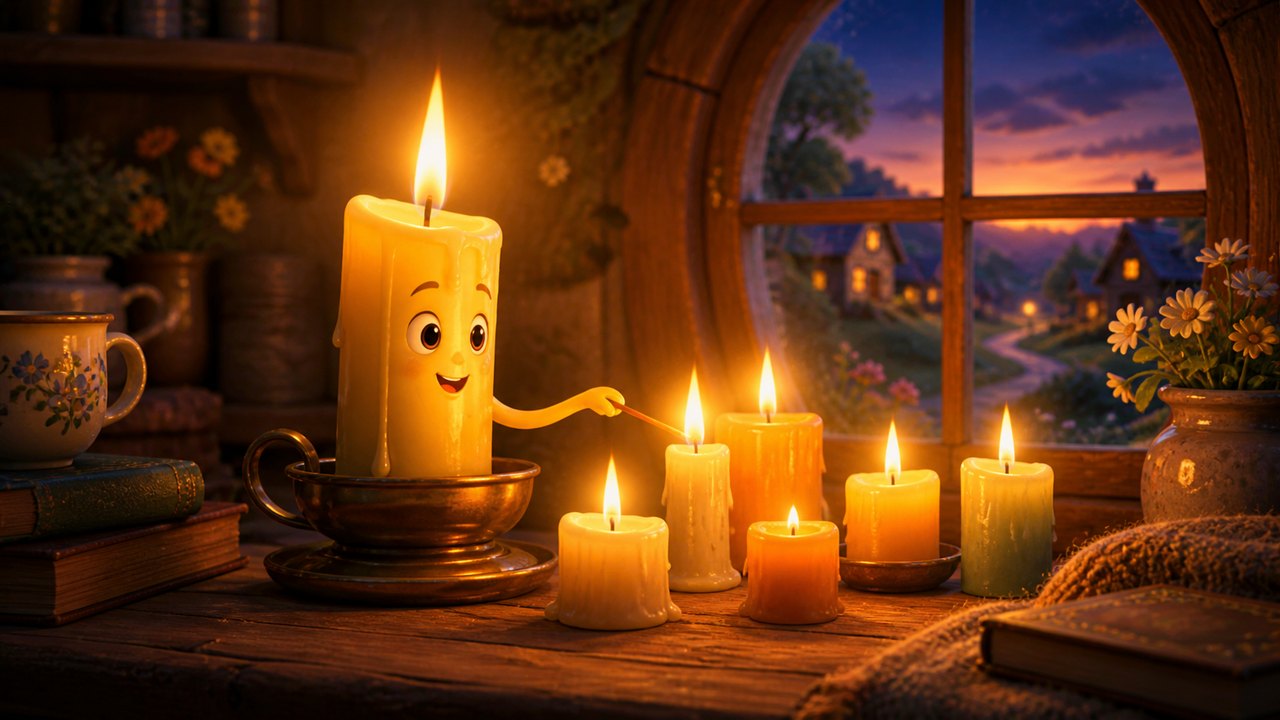
What does a candle fear most? Not the wind—wind is quick and honest. Not the rain—rain is merciful. No. What a candle fears most is the slow, silent shrinking of itself. The quiet disappearance. The moment the wax runs out and the flame has nothing left to hold.
Ember knew this fear intimately. She was a beeswax taper, tall and golden, standing on a brass holder in the window of a small cottage at the edge of Thornfield village. She had been lit on the first night of winter, and she burned alone.
Outside, the village was dark. The other cottages had no candles—the chandler's shop had burned down in autumn, and the next shipment of wax wouldn't arrive until the river thawed in spring. Ember was the only light for half a mile.
She was proud of this, at first. "Look at me," she whispered to the frost on the window. "The only flame in Thornfield. I matter."
But pride, like wax, melts under heat. And loneliness is a very particular kind of heat.
On the third night, there was a knock at the cottage door. The old woman who owned Ember—a seamstress named Ruth—opened it to find a girl of perhaps ten, holding an unlit candle stub no bigger than a thumb.
"Please," the girl said. Her name was Ada, and her fingers were blue. "My mother is mending nets by touch. She can't see the knots. Could we borrow a bit of flame?"
Ruth looked at Ember. Ember felt the look like a hand reaching toward her.
No, she thought. If I share my flame, I'll burn faster. Two flames from one wick—it will use me up.
But Ruth was already lifting Ada's candle stub toward Ember's tip. The flames touched. For one terrible, beautiful moment, Ember felt herself stretch—pulled thin, divided. And then Ada's stub caught, and a new flame was born, and Ada was gone into the dark with her tiny light bobbing like a firefly.
Ember braced herself. Surely she was shorter now. Surely her wax was draining faster.
She looked down. She was exactly the same height as before.
"That's impossible," she murmured.
The next night, two more knocks. A farmer named Cole with a lantern that had blown out. A boy carrying a pine-pitch torch that wouldn't catch in the cold. Ruth lit them both from Ember's flame, and both times Ember flinched, and both times she lost nothing.
By the seventh night, Ember could see other lights through the window. Ada's stub glowed in the cottage across the lane. Cole's lantern swung in his barn. The boy's torch illuminated the path to the well. And from each of those flames, others had been lit—a whole constellation of borrowed fire spreading through Thornfield like warmth through cold fingers.
"I don't understand," Ember said to Ruth's knitting needles, which were the only things awake at that hour. "I gave my flame away a dozen times. Why am I not smaller?"
The needles said nothing, of course. But the draught under the door carried in the smell of woodsmoke from newly lit hearths, and Ember understood something she had never considered: a flame is not like coin. You do not have less of it when you share. Fire is the one thing in this world that multiplies by division.
And something else—something she hadn't expected. The other lights in the village were warming the air. The frost on her window was thinner. The draught was gentler. The cottage was warmer. By giving her flame away, she had made her own burning easier. She would last longer now, not shorter.
"Oh," she said softly. "Oh, I see."
Winter wore on. More candles came to Ember's window—some tall, some short, some barely more than a wick floating in a dish of oil. She lit them all. She stopped flinching. She stopped counting her inches of wax.
And on the last night of winter, when the river cracked and the supply wagons finally rolled into Thornfield, the villagers gathered in the square with their candles—dozens of them, all lit from a single source. They didn't know it was Ember. They didn't need to. The light was what mattered, not the origin.
But Ruth knew. She carried Ember to the window one final time and let her see the village—every window glowing, every doorstep bright, the whole of Thornfield burning like a fallen star.
"You see?" Ruth whispered, her old fingers gentle on the brass holder. "You were never going to run out, dear. That was never how it worked."
Ember burned until dawn. And when she finally guttered out—as all candles must—she did not go in darkness. She went surrounded by the light she had made possible. A hundred flames, all children of hers, all burning on.
And not one of them was afraid.