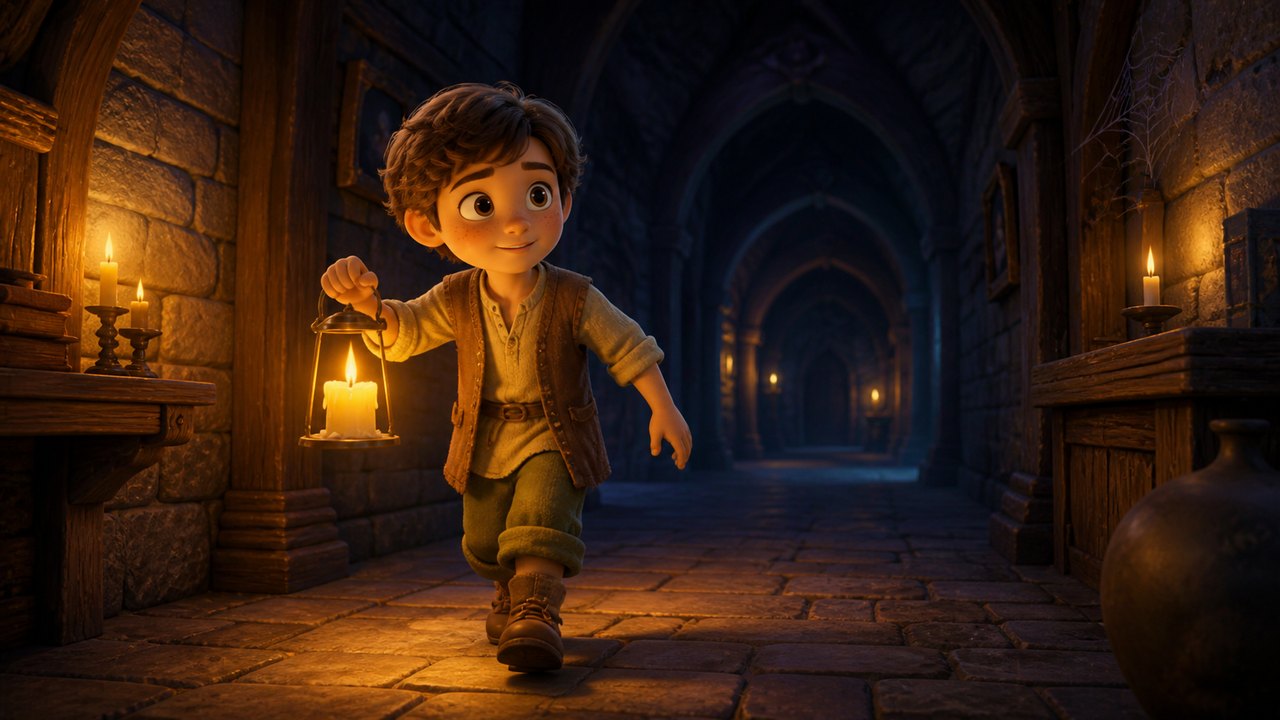
Theo carried light for a living—and he was afraid of the dark.
This was not something he told people. Not his father, who dipped candles twelve hours a day in the workshop behind their house and whose hands were permanently stained the colour of beeswax. Not his mother, who sold the candles at market every Thursday. Not his sister Lina, who was five and afraid of nothing and would have laughed at him.
Theo was eleven. He helped with deliveries. Every week he carried crates of candles to shops, churches, and homes throughout the town of Fennford—all of them during daylight, all of them by familiar routes, none of them requiring him to pass through the one place he could not bear to go.
The Underhall.
It was not a mysterious place. It was simply a corridor—a stone passage beneath the old guildhall that connected the east side of town to the west. In daylight, with its gas lamps lit, it was an ordinary tunnel: arched ceiling, cobbled floor, walls damp with condensation. Hundreds of people used it daily as a shortcut.
But the gas lamps had been broken since October. The guild had not repaired them—some dispute about funding—and now the Underhall was dark. Completely, absolutely, unrelievedly dark. The kind of dark that swallows your hand when you hold it in front of your face.
Theo had not walked through it since the lamps went out. He took the long way around—up Cartwright Hill, across the old bridge, down past the tannery. Twenty extra minutes each way. His father had noticed.
"You're late again," his father said one Tuesday, counting stock in the workshop. "The Widow Pennwell said her order arrived after dark. She needs her evening candles by four o'clock, Theo. You know that."
"The bridge route takes longer—"
"Then use the Underhall. It's three minutes. What's the problem?"
Theo said nothing. How could he explain? He made candles. He was literally surrounded by light every day of his life. And yet darkness—real darkness, the kind without edges—made his stomach twist and his chest go tight and his mind fill with shapes that weren't there.
But on Thursday, the problem solved itself. Or rather, it forced itself.
The Widow Pennwell's order was larger than usual—four dozen tapers for a funeral the next morning. She needed them by three o'clock sharp. Theo's father was ill in bed with a chest cold. His mother was at market with Lina. There was no one else.
Theo stood at the east entrance to the Underhall with a crate of forty-eight candles on his hip. It was two forty-five. The bridge route would take twenty minutes. He would be late. The funeral would have no candles. Mrs. Pennwell would weep.
The Underhall gaped before him. Stone stairs descending into nothing. Not even a grey nothing—a black nothing. A nothing so complete it seemed to have texture, like velvet pressed against his eyes.
Theo's hands were shaking. The candles rattled in their crate.
And then—he thought of something. Something so obvious that he almost laughed, except that his throat was too tight for laughter.
He was carrying forty-eight candles. And in his pocket, as always, was a matchbox.
He set the crate down. He took one taper from the top row—a good beeswax taper, the kind that burned clean and bright. He struck a match. The sound was enormous in the silence. The flame jumped to the wick and caught, and suddenly Theo was holding a small sun in his hands.
The Underhall appeared around him. Not all of it—just a circle, perhaps ten feet across. Stone walls. Cobbled floor. A puddle. A crack in the ceiling where tree roots had pushed through. Nothing else. Nothing hiding. Nothing waiting.
Just empty space. Just a corridor that had been there for two hundred years, doing nothing more sinister than connecting one street to another.
Theo picked up the crate with his free hand and began to walk.
His footsteps echoed. The candle flame wavered with each step, and the shadows moved—but they moved away from him. That was the thing he had never understood about darkness: it doesn't advance. It retreats. Wherever you bring light, the dark pulls back like a curtain. It has no choice. It is not a force. It is an absence. And you cannot be hurt by an absence.
He was halfway through when the candle guttered. A draught from somewhere—a crack in the wall, a ventilation gap. The flame shrank to a blue whisper. For one terrible second, the dark rushed back in like water filling a hole, and Theo felt the old fear grab his ribs.
He stopped. He cupped his hand around the flame. He breathed slowly—in through his nose, out through his mouth—the way his father breathed when dipping wicks into hot wax, steady and controlled. The flame steadied. It grew. The circle of light returned.
"You're just empty," Theo said to the dark. His voice sounded strange in the tunnel—small but solid. "You're not anything. You're just where the light hasn't reached yet."
He walked on. Step by step, circle of light by circle of light, until the stairs at the far end appeared—and beyond them, the grey November afternoon, which had never looked so beautiful.
He delivered the candles to Mrs. Pennwell at two fifty-eight. She counted them, nodded, and said, "One short."
Theo looked down at the taper in his hand—burned halfway down now, wax dripping over his fingers. "Sorry," he said. "I needed it."
Mrs. Pennwell looked at the candle. Looked at Theo's face—flushed, a little damp, but steady. She smiled in a way that suggested she understood more than he'd said.
"Keep it," she told him. "Forty-seven is plenty for a funeral. But a boy who's just learned to carry his own light—that's worth more than any candle I could sell."
Theo walked home through the Underhall. He lit the candle again at the entrance, but this time his hands did not shake. The dark was the same. The corridor was the same. The only thing that had changed was Theo—and that, it turned out, was the only thing that ever needed to.
He used the Underhall every day after that. And every time, he carried a candle. Not because he still needed it—eventually, he could walk the passage with his eyes closed, counting steps—but because it reminded him of something important: you are never powerless in the dark. Not when you carry your own light.