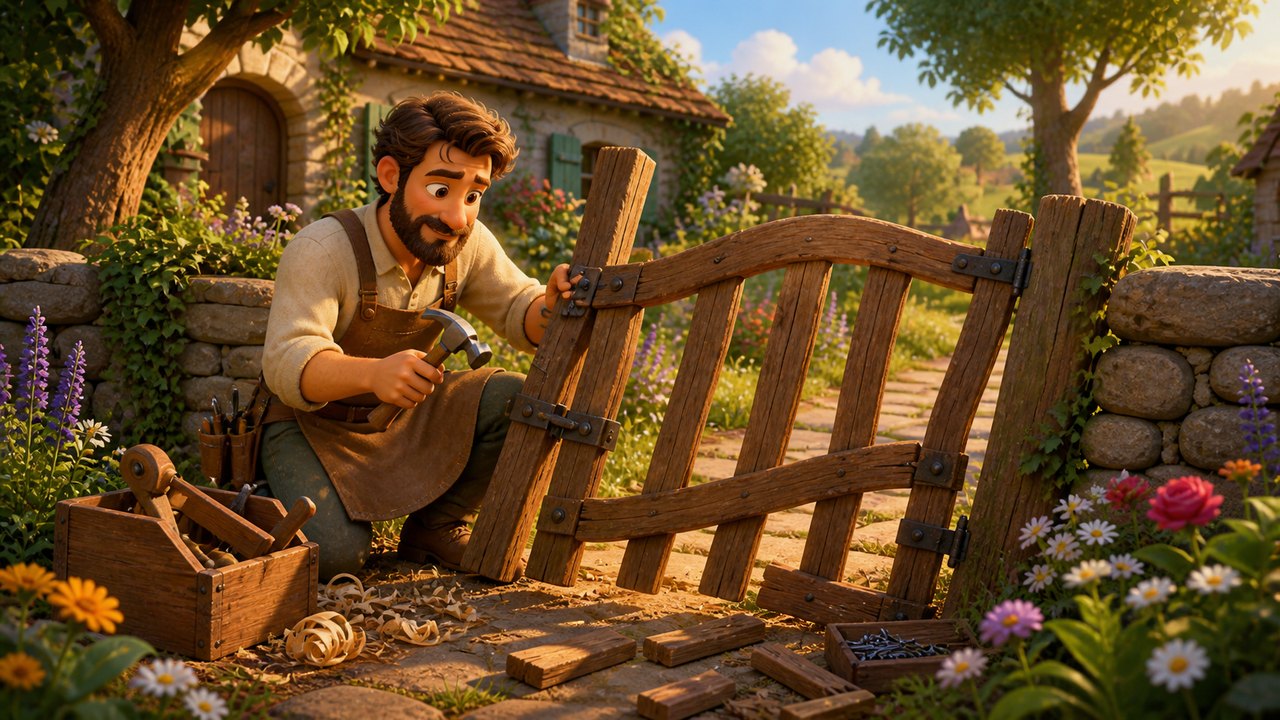
Jonas could smell the lie before he spoke it. It tasted like sawdust and copper—the flavour of a shortcut taken and a standard abandoned.
He stood in the dooryard of the Widow Harken's cottage, his toolbox at his feet, staring at the gate he had just finished hanging. It was crooked. Not dramatically—not the kind of crooked a stranger would notice from the road. But crooked enough that the latch didn't quite catch, and the bottom rail scraped the flagstone when you swung it open, and the whole thing leaned three degrees to the left like a man who'd had too much cider.
Jonas knew why. He had cut the hinge-post a quarter inch too short, and instead of starting over—instead of walking back to his shop for a new piece of oak—he had shimmed it with a scrap of pine. Pine against oak. Soft wood against hard. It would hold for a while. Maybe a season. Maybe two.
But not forever. Jonas knew that. He knew it the way a baker knows when the bread is underdone—in his hands, in his gut, in the part of his craft that never lies even when his mouth does.
The widow came out. She was seventy, small, with hands knotted by decades of needlework. She looked at the gate and smiled.
"Oh, Jonas. It's lovely."
Here was the moment. The fork in the road. Jonas could say: Actually, Mrs. Harken, I made an error. Let me take it down and do it properly. It'll cost you nothing extra—it was my mistake. That would take an hour. Maybe two. He would lose the afternoon. He had three other jobs waiting.
Or he could say—
"Solid as the day is long," Jonas heard himself say. "Oak all the way through. That gate will outlast both of us."
The widow pressed a coin into his palm. "You're a good man, Jonas. Your father would be proud."
He walked home with the coin burning in his pocket like a lit coal.
That night, Jonas couldn't sleep. He lay in his bed above the workshop, listening to the wind push against the shutters, and thought about the pine shim. It was such a small thing. A quarter inch of soft wood in a joint that bore the whole gate's weight. No one would ever know.
Except Jonas. Jonas would always know.
He told himself it didn't matter. He told himself he'd fix it in spring, when things slowed down. He told himself the widow barely used the gate anyway—she was old, she rarely went out, what difference did it make?
Autumn came and went. Winter came and stayed. And one night in February, the kind of storm that only visits once a decade came howling down from the northern mountains. It tore shutters from hinges and sent roof tiles spinning through the dark like playing cards. It bent the old elm in the square nearly double. And at the Widow Harken's cottage, it found the crooked gate.
The pine shim—swollen by months of rain, weakened by frost, never meant to bear such weight—splintered. The hinge-post twisted free. The gate tore loose and went spinning into the road, where it shattered against the stone wall of the churchyard.
In the morning, Jonas walked through the village surveying damage. He was calm until he reached the widow's cottage. Then he stopped. The gateposts stood bare, the hardware dangling. Splinters of oak and pine littered the path. And there, on her doorstep, sat the Widow Harken with a blanket around her shoulders and a bruise on her forearm.
"The gate caught me when it went," she said. Not accusing. Not angry. Just tired. "I was trying to latch it against the wind. It came apart in my hands."
Jonas felt the lie rise in his throat again—the storm was too strong, no gate could have held, it wasn't my fault—but this time he swallowed it. He swallowed it because he could see the bruise, purple and real, and he knew where it came from. Not from the storm. From a quarter inch of pine.
"Mrs. Harken," he said. His voice was rough. "I need to tell you something."
He told her everything. The short-cut post. The pine shim. The lie about solid oak. He told her standing in her dooryard with his hat in his hands and his reputation crumbling like the gate had crumbled, and he did not look away.
The widow was quiet for a long time. Then she said: "I know."
Jonas blinked. "You—what?"
"I'm old, Jonas. Not blind. I saw the gate leaning the day you hung it. I heard it scraping. I smelled the pine—it's sweeter than oak, you know. Anyone who's burned firewood knows the difference."
"Then why didn't you say something?"
"Because I wanted to see if you would." She pulled the blanket tighter. "Your father never would have let a crooked gate leave his shop. But your father also never would have lied about it. The crookedness I could have lived with. The lie is what broke my trust."
Jonas built her a new gate. He used oak—all oak—and he measured twice and cut once and checked every joint with a spirit level until it was true. He charged her nothing. He hung it himself in the rain, and when he was done he stood back and looked at it, and it was straight, and it was honest, and it was the best gate he had ever made.
Not because the wood was better. Because he was.
"Thank you," the widow said. And this time, when she smiled, Jonas could meet her eyes.
He never shimmed another joint with pine. And every morning after, when he walked past the Harken cottage on his way to the shop, he looked at that gate—straight and true and holding fast—and remembered: a small lie is just a crooked gate that hasn't met its storm yet.