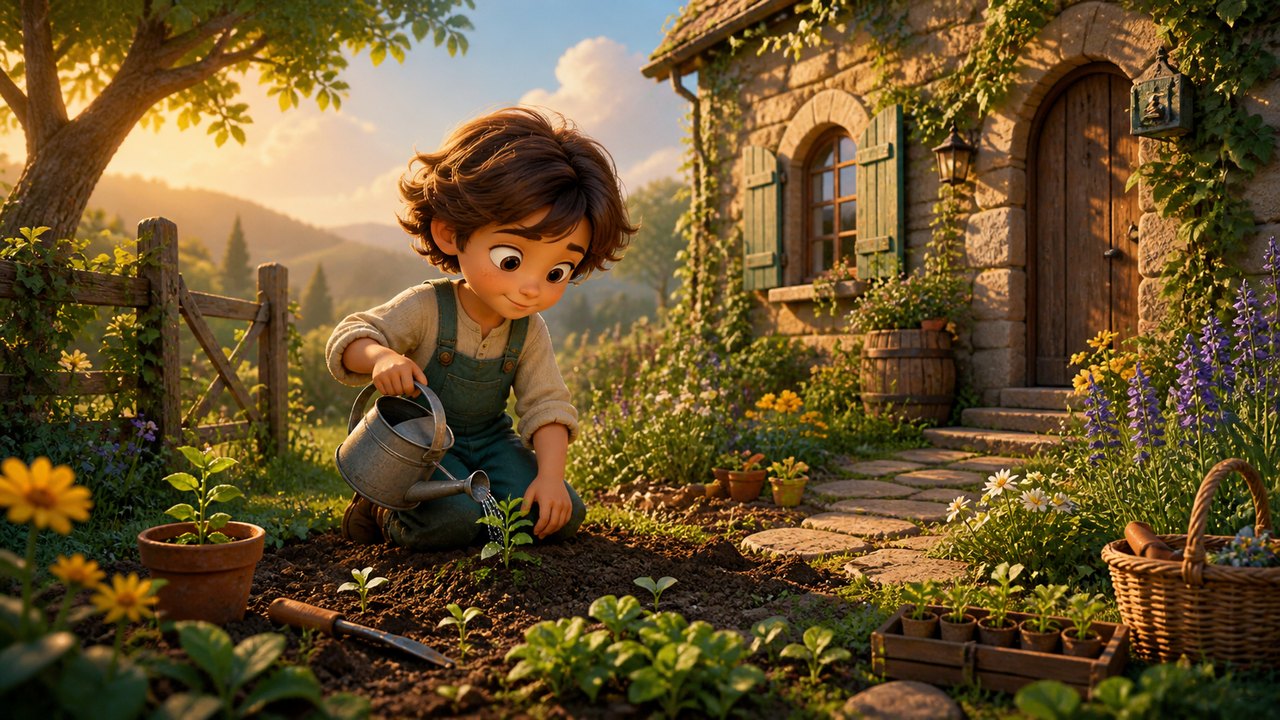
The garden had been waiting for three months when Lila finally came.
It waited the way gardens do — not with impatience but with a kind of vegetable faith, roots holding their ground, seeds sleeping in soil that remembered the shape of hands long gone. Grandmother's hands. Hands that had turned this quarter-acre behind the stone cottage into something people used to detour just to see.
Now the gate hung crooked. Bindweed strangled the roses. The tomato cages had tipped like drunken soldiers, and the herb bed was a democracy of weeds where no one was in charge.
Lila stood at the gate, twelve years old and furious about it. She didn't want a garden. She wanted her grandmother back. But Grandmother was gone, and in her will she'd written: The garden goes to Lila, who has the hands for it.
"I don't have the hands for anything," Lila muttered. She kicked the gate open and walked in.
Her plan was simple. She'd fix it in a weekend. Buy new plants, pull everything dead, make it look like the photographs. She'd seen people do garden makeovers on television — they always finished in an afternoon with time left for lemonade.
Saturday: she pulled weeds for six hours straight. Her back screamed. Her hands blistered. She cleared perhaps a tenth of the mess and collapsed on the garden bench, crying from frustration.
"You can't rush me," the Garden said.
Lila sat up. "Who said that?"
"I did." The voice was everywhere and nowhere — in the rustle of the remaining leaves, in the creak of the old apple tree, in the whisper of soil settling after rain. "You're pulling too hard. You're breaking roots that aren't weeds."
"Everything looks like weeds," Lila said, wiping her eyes with a dirty hand.
"That's because you don't know me yet. Your grandmother did. She learned me over thirty years, one morning at a time."
"I don't have thirty years."
"You don't need thirty years. You need thirty mornings. Can you give me that?"
Lila looked at the chaos around her. Thirty mornings. Not one heroic weekend. Not a television miracle. Just... showing up. "What would I even do?"
"Come at dawn," the Garden said. "Bring water. I'll show you what needs tending."
She almost didn't come back. Sunday she slept until noon and told herself the garden was a lost cause. But Monday morning, something woke her at six — a quality of light through her window, maybe, or the feeling of her grandmother's hand on her shoulder in a half-remembered dream.
She went. She brought water.
"Start here," the Garden said, directing her attention to a patch near the south wall where something green and intentional was fighting through the weeds. "That's lavender. Your grandmother planted it the year you were born."
Lila knelt and carefully cleared around the struggling plant. It took twenty minutes for one small patch. When she stood, barely anything looked different.
"That's it?" she asked. "That's a whole morning's work?"
"That's a whole morning's work," the Garden confirmed. "Come back tomorrow."
She came back tomorrow. And the day after. And the day after that. Each morning the Garden directed her — here, pull this (weed); there, leave that (self-seeded foxglove); water this, prune that, just sit and watch this corner for ten minutes and tell me what you see.
The changes were invisible day to day. Like watching a clock — you never see the hands move, but somehow an hour passes. The lavender straightened. Roses emerged from their bindweed prisons, pale and blinking like creatures released from long captivity. The herb bed began to sort itself under Lila's increasingly confident hands: thyme here, sage there, the mint quarantined in its pot because — as the Garden warned her — "mint has no manners."
On the fifteenth morning, Lila found a tomato. Small, green, hard as a marble. But alive and growing on a vine she'd staked herself with twine from Grandmother's shed.
"I grew that," she whispered.
"We grew that," the Garden corrected gently.
On the twenty-third morning, her neighbor Mrs. Patterson stopped at the gate. "Lila! It's starting to look like your grandmother's again."
Lila looked around. She hadn't noticed — it had happened so gradually — but Mrs. Patterson was right. Not identical. Not a replica. But alive in the way it used to be, with that same feeling of being tended. Cared for. Loved in small daily increments rather than one grand gesture.
"My grandmother was here every morning, wasn't she?" Lila asked the Garden that evening, sitting on the bench with dirt under her fingernails and the good ache of honest work in her shoulders.
"Every single one," the Garden said. "Rain or shine. Even when nothing was blooming. Even when everything looked dead. She showed up, and showing up was the whole secret."
"It's not very dramatic."
"No," the Garden agreed. "Responsibility never is. But look what it makes."
Lila looked. Lavender bloomed purple against the stone wall. Tomatoes ripened on steady vines. A bee moved between the sage flowers with the contentment of someone who has found exactly where they belong.
It wasn't perfect. It might never be perfect. But it was hers — earned not in a weekend but in thirty mornings of quiet, unglamorous, irreplaceable care.