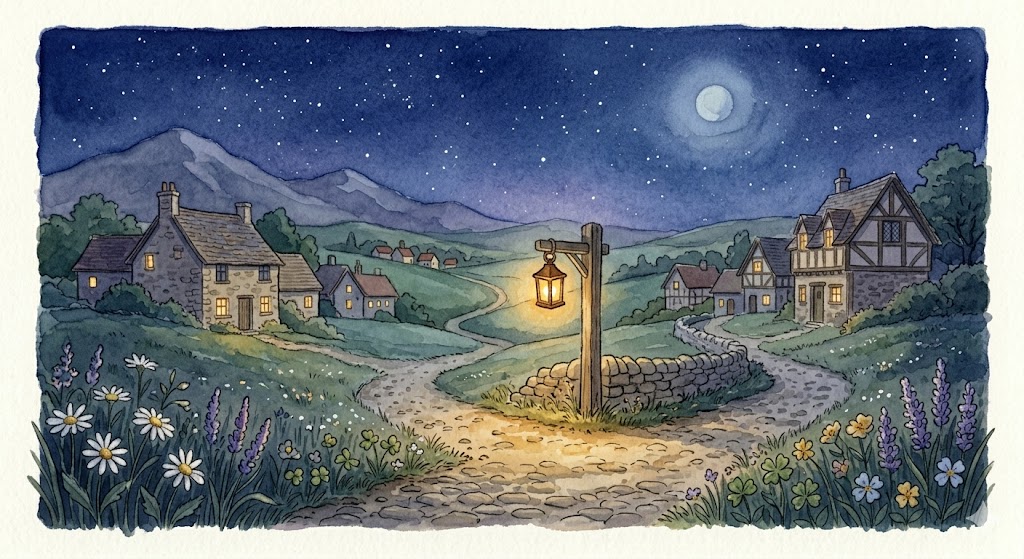
At the edge of Brindlewood village, where the cobblestones gave way to packed earth and the packed earth narrowed into a ribbon of dust, there hung a lantern named Pip. He was small — barely bigger than a man's fist — and his glass was clouded with age. The iron hook that held him to the post had rusted into a permanent curve, like a question mark asking the sky for permission.
Every evening, the lamplighter would pass with his long pole and touch flame to the big lanterns on Main Street. Their wicks were thick as thumbs. Their light pooled wide and golden across the square. But the lamplighter never came down the little road. It was too far, too narrow, too unimportant.
"You could light yourself, you know," said the Road one evening.
Pip startled. He had not known roads could speak. "I beg your pardon?"
"I said," the Road repeated, her voice like gravel shifting under a gentle foot, "you could light yourself. You have a wick. You have oil — I can smell it. What are you waiting for?"
"I'm waiting for the lamplighter," Pip said quickly.
"He isn't coming."
"He might."
"He hasn't come in fourteen years."
Pip was quiet for a long time. A beetle crossed the Road's surface, its shell clicking against the stones. Somewhere in the village, a dog barked twice and stopped.
"The thing is," Pip finally said, "even if I did light myself — and I'm not saying I can — what good would it do? Look at me. I'm the size of a teacup. The Main Street lanterns throw light thirty feet in every direction. I'd be a joke. A firefly pretending to be the sun."
The Road chuckled, a sound like two smooth stones rubbing together. "You think I need thirty feet of light? Pip, I am four feet wide. I don't need a bonfire. I need someone to show where the puddles are."
"The puddles?"
"And the roots. And that loose stone near the miller's fence that catches everyone's toe. Old Greta tripped there last Tuesday. Bruised her knee something terrible."
Pip thought about Old Greta, who walked slowly with her cane and brought bread to the widow at the end of the lane. He thought about the children who ran home after dark from the schoolhouse, their feet uncertain on the uneven ground. He thought about the doctor, who sometimes hurried this way at midnight when the baby at the Farrow house was sick.
"But what if my light isn't enough?" he whispered.
"Enough for what?" the Road asked. "Enough to illuminate the whole valley? No. Enough to show one person where to put their next step? Yes. That's all anyone needs in the dark, Pip. Just the next step."
The night deepened. An owl called from the church tower. The moon hid behind a bank of clouds as if it, too, wanted to see what Pip would do.
He concentrated. It had been so long since he'd tried. He remembered the feeling — that gathering warmth at the center of his wick, like taking a deep breath before speaking. For a moment, nothing happened. Then a spark caught. Tiny. Barely visible. A dot of orange no bigger than a seed.
"There," the Road said softly. "There you are."
"It's so small," Pip said, embarrassed.
"Look down."
Pip looked. Below him, a circle of warm light touched the Road's surface — perhaps five feet across. And in that circle, he could see everything: the crack where dandelions grew, the patch of mud from yesterday's rain, the nail that had worked loose from the fence post.
"Now look further," the Road said.
Pip raised his gaze. Coming from the village end of the lane was a figure — small, hunched, moving carefully. It was Old Greta, her cane tapping ahead of her like a blind person's stick. She was heading toward the widow's cottage with something tucked under her arm.
When she reached Pip's circle of light, she stopped. She looked up at him with surprise, then with something softer.
"Well," she said. "Well, well. Someone's finally woken up." She patted the post as if it were a faithful dog. Then she walked on, her cane finding the ground more confidently now, her steps steadier within those five feet of borrowed gold.
Pip burned all night. His flame never grew larger. It never threw light thirty feet or twenty or even ten. But it didn't need to. The Road guided people to him, and he showed them the five feet that mattered most — the five feet directly beneath their shoes.
The doctor came at midnight and didn't stumble. The Farrow boy came home from his late shift at the mill and whistled a tune instead of cursing the dark. A cat sat in Pip's warmth for an hour, purring against the post.
Near dawn, as Pip's oil ran low and his flame flickered toward sleep, the Road spoke once more.
"Pip?"
"Mm?"
"Was it enough?"
Pip thought of Greta's steady steps. The doctor's sure feet. The boy's whistle echoing between the hedgerows. The cat's purr vibrating against old wood.
"It was exactly enough," he said.
And the Road, who had carried a thousand travelers and never once been thanked for it, smiled in the way that roads do — by settling a little deeper into the earth, content.