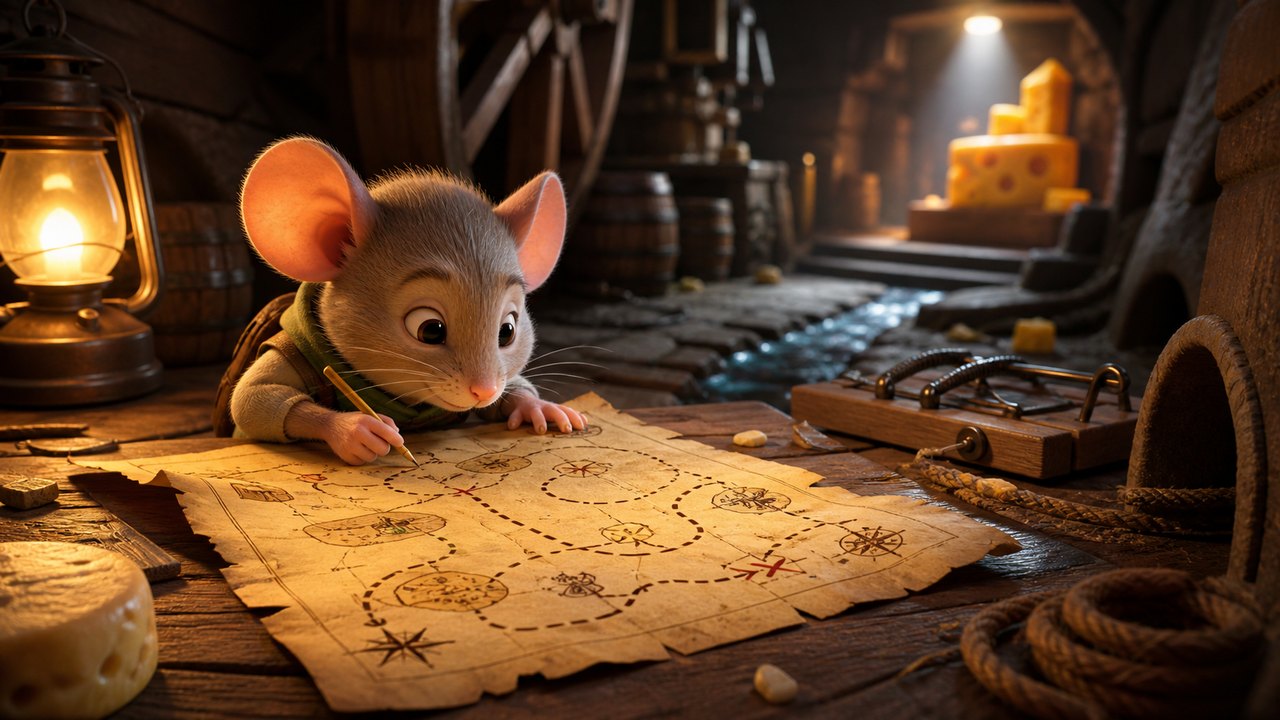
The map was perfect.
Pip had found it tucked inside the wall of the old house, between the plaster and the lath, folded into a square no bigger than his thumbnail. When he opened it, carefully, reverently, beneath the glow of a birthday candle he'd salvaged from the kitchen trash, he saw everything: the pantry layout, the shelving heights, the distances between cupboards. And there, marked with a tiny red X, the location of the cheese.
Not just any cheese. The map's faded caption read: Aged Gruyère. Top shelf. Glass dome. Unwatched after midnight.
Pip's whiskers trembled with longing.
He showed the map to his grandmother, Hazel, who lived in the adjacent wall space and had survived in this house for four years — a lifetime, by mouse standards.
"Where did you find this?" she asked, turning it over in her paws.
"Behind the baseboard in the study. Someone drew it — another mouse, I think. Look at the detail! Every shelf, every path. It's perfect, Grandmother."
Hazel studied the map for a long time. Then she set it down and looked at Pip with her good eye — the other lost to a spring-trap two years ago.
"What isn't on this map, child?"
"What do you mean? Everything is on it. Every shelf, every—"
"The cat," Hazel said. "Where is the cat?"
Pip looked. The map showed walls, shelves, the path from the mouse-hole to the pantry. No cat. "Maybe there wasn't a cat when this was drawn."
"There is always a cat, Pip. And where is the trap? The one by the stove — is it marked?"
Pip's stomach tightened. He looked again. No trap. "Maybe it wasn't there—"
"And the rain," Hazel continued. "When it rains, the kitchen floor floods near the back door. The map doesn't show weather." She folded the paper and handed it back. "A map shows you where things are. It cannot show you what might happen along the way. It is a picture of the world standing still. But the world, child, never stands still."
"So what — I should just never go? The cheese is right there."
"I'm not saying never. I'm saying not tonight. Watch first. Learn the cat's schedule. Learn when the humans sleep deeply and when they stir. Learn where the new traps are. Then go."
"How long will that take?"
"As long as it takes."
Pip did not have that kind of patience. He was young and hungry and the map was right there in his paw, promising everything. He told himself: Grandmother is old. Cautious. She lost her eye because of one mistake and now she sees danger everywhere. The map is good. The map is detailed. The mouse who drew it clearly made it to the cheese and back — otherwise how could they have drawn the return path?
He went that night.
The kitchen was dark. The map said: straight across the tile, past the stove, right at the icebox, and up the shelving brackets to the top. Simple. Clear. Pip ran.
He made it past the stove. The trap was new — shiny, baited with peanut butter — and it was exactly where his grandmother said it would be. He saw it just in time, his front paw grazing the trigger plate before he jerked back, heart hammering.
He pressed himself against the baseboard, breathing. Okay. One thing the map missed. Fine. He'd be more careful. He continued.
The cat was asleep on the kitchen chair. The map hadn't mentioned the kitchen chair because it was a map of shelves and floors, not furniture. Pip had to detour wide, pressing himself flat against the cold tile, moving inches at a time past a creature that could end him with one lazy swipe.
It took forty minutes to cross what the map suggested would take forty seconds.
Then the rain started.
Water seeped under the back door, spreading across the tile like a cold silver tongue. Pip's paws splashed. The cat's ear twitched. Pip froze for ten minutes — ten eternal minutes — until the cat settled again.
By the time Pip reached the shelving brackets, he was soaked, exhausted, and shaking. He climbed. His paws slipped twice on wet wood. But he made it. The top shelf. The glass dome.
It was empty.
Someone had eaten the Gruyère — maybe last week, maybe last year. The glass dome sat over nothing but a few dried crumbs and a faint, ghostly smell of what had once been magnificent.
Pip sat on the top shelf, wet and trembling, and understood. The map was accurate. Every wall, every distance, every turn — all correct. But it was a map of a moment that no longer existed. The world had moved on. The cheese was gone. The cat was new. The trap was new. The rain was tonight's rain, no one else's.
He crept home by a longer, safer route that wasn't on the map at all — one he discovered by going slowly, testing each step, watching and listening and being present in the actual, living, dangerous now.
Hazel was waiting.
"The cheese?" she asked.
"Gone."
"Ah." She didn't say I told you so. She simply made room beside her in the warm space between the walls. "Tomorrow," she said, "I'll teach you to scout. It's slower than a map. But it's always current."
Pip curled up beside her, the useless, beautiful map still clutched in one paw. He'd keep it, he decided. Not as a guide. As a reminder that knowing the destination is never enough — you must also know the journey, and the journey is never the same twice.