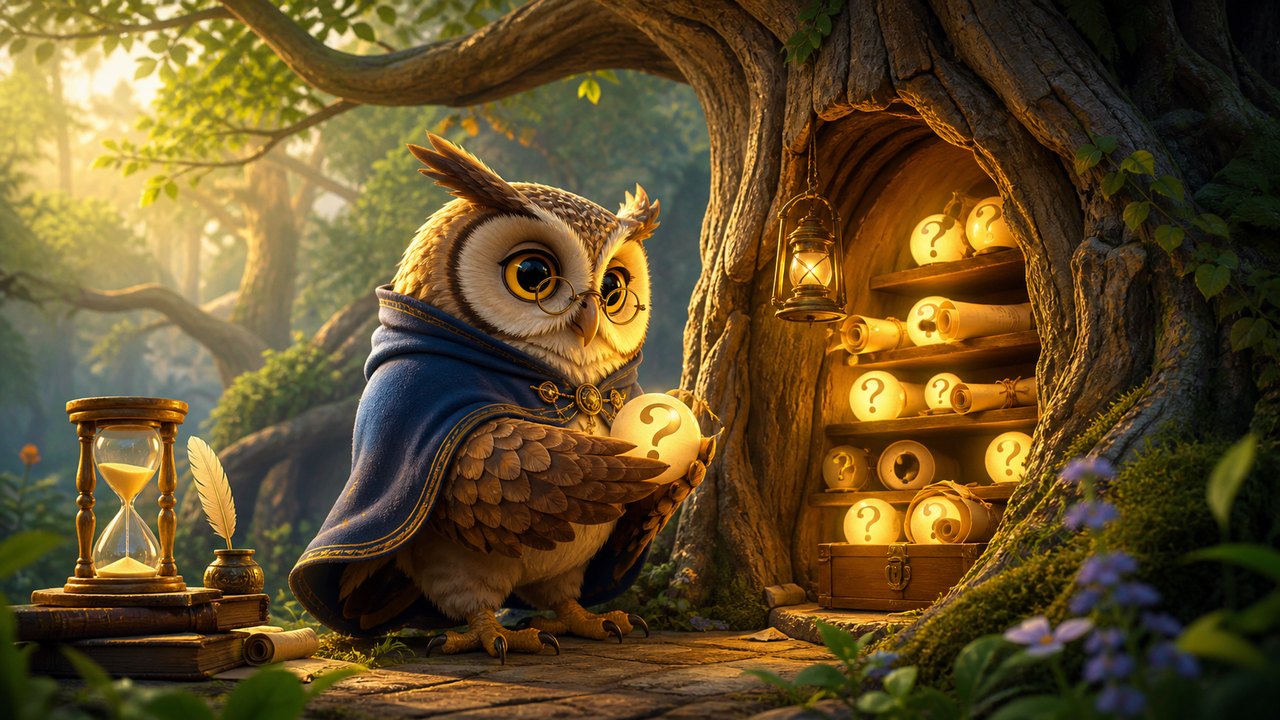
In the hollow of the Great Sycamore — the one so old that its roots had become hallways and its branches were neighborhoods — there lived an owl named Minerva who collected questions.
Not answers. Never answers. Answers, Minerva believed, were dead things. Finished. Closed like fists. But questions — questions were alive. They breathed. They grew. They changed shape depending on who held them and when.
She kept them in jars. Hundreds of jars, lining the curved walls of her hollow, each one labeled in her precise, spidery script. Some were old — Why does the moon change shape? (from a field mouse, spring of the second year). Some were new — Where do songs go when no one is singing them? (from a thrush, just last week).
Animals came to her from across the forest, because everyone knew: Minerva was the wisest creature in Ashwood. They climbed the sycamore's roots, knocked on her bark door, and asked their questions.
And Minerva wrote each one down, placed it carefully in a jar, and said: "Thank you. What a beautiful question."
Then she said nothing else.
This drove some visitors mad.
"But what's the answer?" demanded Rufus the squirrel one autumn afternoon. He had asked: Should I store my acorns in one place or many? "I came all the way up here for help, Minerva. Not to watch you label a jar."
"The question is the help," Minerva said, adjusting her spectacles. "You've been thinking about this for days, yes?"
"Obviously! That's why I'm here!"
"And in those days of thinking — before you climbed up here — did you not already begin to lean toward an answer?"
Rufus paused. His tail twitched. "Well... I mean... many places, probably. In case one gets found. But—"
"There," Minerva said. "You see? The question did its work. It turned you toward your own knowing." She placed his jar on the shelf beside hundreds of others. "I just gave it a home."
"That's infuriating," Rufus said. But he left looking lighter.
Not everyone was so easily satisfied. One winter evening, a young raven named Corvus came to Minerva's door with something urgent and dark in his eyes.
"I have a question," he said, "and I need a real answer. Not your jar trick."
Minerva regarded him calmly. "Ask."
"Why did my mother leave?" His voice cracked on the last word. He was young — barely fledged — and the question was not academic. It was a wound.
Minerva was quiet for a long time. The hollow creaked in the wind. Jars clinked softly against each other like distant bells.
"I don't know why your mother left," she said at last. "I could guess. I could invent reasons that might comfort you or reasons that might make you angry. But none of them would be true, because I am not your mother and I cannot see inside her heart."
"Then what good are you?" Corvus snapped. "What good are all these questions if none of them get answered?"
"Come here," Minerva said. She led him to a particular shelf — the oldest shelf, where the jars were dusty and the labels had faded. She pulled one down. The label read: Why did my sister stop speaking to me? — Minerva, Year One.
"That's yours?" Corvus asked.
"The first question I ever saved. I was young. I wanted an answer so badly I thought I'd die without one." She turned the jar in her talons. "I never got an answer. My sister died three years later. We never spoke again."
"That's terrible."
"Yes. But the question — the living with the question — taught me something no answer could have. It taught me to sit with not-knowing. To let uncertainty be a companion rather than an enemy." She replaced the jar. "Some questions aren't meant to be solved, Corvus. They're meant to be carried. And the carrying makes you stronger."
Corvus stared at the shelves. Hundreds of jars. Hundreds of unanswered questions, each one someone's confusion or pain or wonder, held gently in glass and given space to exist without resolution.
"Could you..." he started, then stopped. Then: "Could you save mine? My question?"
"Of course."
She wrote it down in her precise script: Why did my mother leave? — Corvus, third winter. She placed it in a clean jar and set it on the shelf at his eye level, where he could see it whenever he visited.
"It doesn't fix anything," he said.
"No," Minerva agreed. "But it honors it. Your confusion is real and it matters and now it has a place to live that isn't only inside your chest."
Corvus came back. Not every day, not even every week. But sometimes he climbed the sycamore and sat among the jars and looked at his question glowing softly in the afternoon light. And over time — not quickly, not dramatically — the weight of it changed. Not lighter exactly. But more bearable. Shared.
Years later, when animals asked Corvus about Minerva — the strange owl who collected questions but never answered them — he said the same thing every time:
"She taught me that wisdom isn't having all the answers. It's knowing which questions to hold onto — and which ones to let hold you."