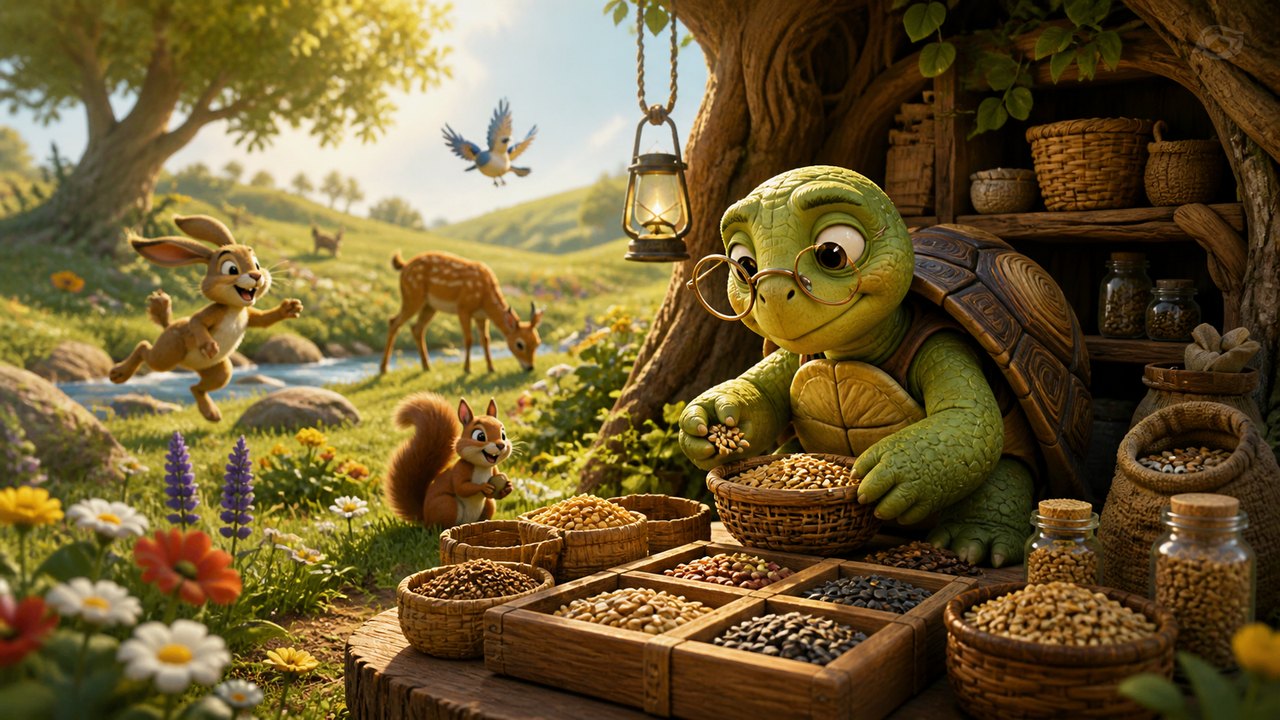
"Tomorrow," said Hester. She said it the way most creatures say "good morning"—automatically, without thinking, as natural as breathing.
Her neighbour, a finch named Pip, had asked if Hester would help repair the bridge over Currant Creek. It was a small bridge, just three planks wide, and one plank had rotted through in last week's rain.
"Tomorrow I'll have more energy," Hester explained, pulling her head slightly into her shell. "Today isn't quite right for bridge work."
Pip tilted his head. "You said that yesterday."
"Did I?" Hester blinked her slow, amber eyes. "Well. Tomorrow, then. For certain."
This was Hester's way. She was not lazy, exactly. She was not unkind. She simply believed—deeply, thoroughly, in the marrow of her ancient bones—that tomorrow was a better day for doing things. Tomorrow she would fix the loose stone in her garden wall. Tomorrow she would write back to her cousin in the eastern marsh. Tomorrow she would learn to swim, organize her pantry, read that book about stars.
Her shell was covered in tiny scratches—reminders she had carved for herself over the years. "Fix roof—tomorrow." "Plant herbs—tomorrow." "Visit Mother's grave—tomorrow." There were so many scratches now that they overlapped, and she could no longer read most of them.
The seasons turned. Hester watched them from her doorstep with a cup of clover tea, always planning, never starting. Spring was too wet for outdoor work. Summer was too hot. Autumn was too busy with falling leaves. Winter was too cold. And so the wheel turned, and turned, and turned again.
One October morning, Hester woke to find a young tortoise sitting on her garden wall. He was small—barely bigger than a river stone—with bright, curious eyes and a shell still soft at the edges.
"Are you Hester?" he asked.
"I am."
"My grandmother told me about you. She said you were going to build a library for the meadow. With shelves for everyone's stories."
Hester felt something cold move through her chest. "I—yes. I was going to do that."
"When?"
The word came to her lips like an old friend: "Tomorrow." But this time, it stuck. It sat on her tongue like a stone, and she could not swallow it down.
"Your grandmother," Hester said carefully. "Who was she?"
"Maren. She lived by the creek."
Maren. Hester remembered her—a quick, laughing tortoise with a red streak on her shell. They had been young together, once. Maren had asked Hester to build the library forty years ago.
"She's gone now," the young tortoise said. Not sadly—just factually, the way children state things they don't fully feel yet. "She waited a long time for that library."
Hester set down her tea. Her hand was trembling. She looked at the scratches on her shell—decades of tomorrows, layered so thick they had become meaningless. She looked at her garden wall, which had been missing a stone since before this child's grandmother was born. She looked at the empty patch of earth where the library was supposed to stand.
And for the first time in her long, slow life, Hester felt the weight of all those tomorrows. Not as possibility—as loss.
"What is your name?" she asked the young tortoise.
"Corin."
"Corin." Hester stood up. Her joints ached. Her shell felt heavier than it had yesterday. But she stood. "Would you like to help me do something today?"
Corin's eyes went wide. "Today? What are we doing?"
Hester looked at the empty patch of earth. "We're going to start building a library."
They didn't finish it that day. Of course they didn't—it was a library, not a sandcastle. But they cleared the ground. They measured the space with sticks. They carried the first three stones from the creek bed and set them in a line.
It was not much. But it was something. And something, Hester realized, was infinitely more than tomorrow.
That evening, as the sun dipped below the meadow's edge, Hester took a rough stone and scratched something new into her shell—not a task, but a promise: "Today."
Pip flew down from his branch and landed on the garden wall. He looked at the three stones laid in a row, at the measured ground, at the old tortoise with dirt on her claws and something new in her eyes.
"You started," he said.
"I started," Hester agreed.
"What about the bridge?"
Hester was quiet for a moment. Then she smiled—slow and wide, the way only a tortoise can.
"Tomorrow," she said. And then she caught herself, and laughed. "No. No, not tomorrow. First thing in the morning. Will you hold me to that?"
"Every single time," said Pip.
And he did. And she kept her word. Not perfectly—she was still Hester, still slow, still prone to dreaming in her doorway. But she had learned the one lesson that no amount of tomorrows can teach you: that the only day you can actually live in is this one. And if you waste it waiting for a better one, you will find, at the end of all your years, that you were never really here at all.
The library took three years to build. It was crooked in places, and the door stuck in wet weather. But it stood. And on the shelf nearest the window, in a place of honour, sat a single book—hand-bound in soft leather, with a title stamped in gold: Stories Maren Told.
Hester had written them down from memory. Every single one. Today.