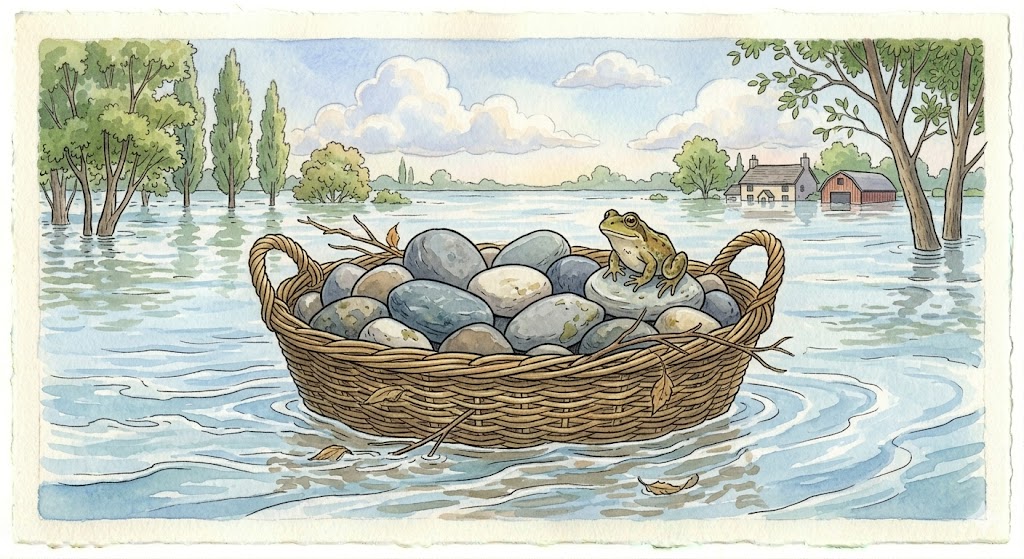
The river had been whispering all week. Old Miriam, the willow basket, knew the sound — that low murmur beneath the current that meant snowmelt in the mountains, days of rain upstream, water rising toward places it didn't belong.
She sat on the bank beside the crossing stones — seven smooth, heavy rocks that the villagers had placed generations ago so people could step across the shallow ford. The stones had names, given by children over the years: Grandfather (the largest), Marble, Flat-Top, Wobble, Penny, Little Duke, and Smidge.
"It won't reach us," Grandfather declared, as the water crept higher. "It never has."
"There was the flood of the dry year," Miriam said quietly. "Before your time. The water moved the old stones half a mile downstream."
"Stories," Marble scoffed. "We're river stones. We belong in the river. Water doesn't frighten us."
"It isn't about fear," Miriam said. "It's about being carried where you don't want to go."
By morning, the water was at Smidge's chin. By noon, Little Duke was underwater completely, and Wobble was living up to his name, rocking against the current.
"Something must be done!" Penny cried. "I can feel the riverbed shifting beneath me."
"Then hold tighter," Grandfather commanded. "Dig in. Be immovable. That is what stones do."
They tried. They pressed themselves into the silt with every ounce of their weight. But water is patient, and silt is not loyalty — it moves when pressured, regardless of who asks it to stay.
By evening, Flat-Top had tumbled three feet downstream, wedged sideways against a root. Wobble was gone entirely, rolling somewhere beneath the brown surge. The remaining stones were frightened now, though only Penny would admit it.
"Miriam," Penny called over the roar. "What do we do?"
Miriam had been watching the water carefully. She knew her own body — woven willow strips, soaked and flexible, lighter than any single stone but shaped to hold things together. She'd carried apples to market. She'd carried a child's collection of acorns. She'd never carried anything as heavy as river stones.
"Get in," she said, floating herself to the edge of the nearest stone. "All of you. Get in and I'll carry you to the high bank."
"In you?" Grandfather's voice was incredulous. "You're made of sticks. You'll break apart."
"I'm made of willow," Miriam corrected. "Willow bends."
"This is absurd," Marble said. "A basket leading stones? We're ten times your weight."
"Eleven times, actually," Miriam said. "But weight isn't the only thing that matters in a flood. Buoyancy matters. Flexibility matters. Knowing when to stop fighting the current and start working with it — that matters most of all."
A surge of brown water rolled over Marble, spinning him half a turn. When he surfaced, sputtering, his pride had washed noticeably thinner.
"Fine," he said. "But if you break—"
"Then you'll be no worse off than you are now," Miriam finished. "Smidge, you first. You're smallest and the current is pulling hardest at you."
Smidge tumbled gratefully into the basket. Miriam's woven walls flexed outward, absorbing the weight, her strips creaking but holding. She adjusted, let the current push her slightly sideways, found the angle where the water's force and her buoyancy balanced.
"Penny. Little Duke — yes, I see you behind that root. Come."
One by one, the stones rolled into her. Each one made her sink lower. Each one made her walls bow wider. The water pressed against her from every side, finding gaps between her weave, pouring through and pouring out. She didn't try to keep it out. She let it flow through her — that was the secret. A rigid box would have filled and sunk. Miriam let the river pass through her body without holding it.
"We're too heavy," Flat-Top groaned from inside. "You should leave Grandfather behind. He's the heaviest."
"No one gets left," Miriam said, her voice strained but steady. "Grandfather, I need you in the center. Your weight will keep us stable if you're balanced."
"You're telling me where to sit?" Grandfather rumbled.
"I'm telling you where you're needed," Miriam replied. "There's a difference."
Grandfather hesitated. Then, slowly, he rolled himself into the basket's center. Miriam sank until her rim barely cleared the waterline. Everything in her creaked. One strip along her left side frayed, then held. She breathed — not with lungs, but with the slow expansion and contraction of willow remembering that it was once a living branch, that it had bent in a thousand winds and survived them all.
"Now," she said, "everyone be still. I'm going to let the current carry us to the bend. The high bank is just past those alders."
"Let the current carry us?" Marble was horrified. "Shouldn't we fight it?"
"Fighting it is how you ended up scattered," Miriam said. "Trust me. Be still."
She angled herself — just slightly, just enough — and the river did the rest. It swept them downstream, spinning gently, and Miriam used her flexibility like a rudder, leaning this way, bowing that way, guiding without forcing. The alders appeared. The bank rose. The current slowed in the eddy behind the bend, and Miriam grounded softly against the muddy shore.
"Out," she said. "Quickly, before the next surge."
The stones tumbled onto the high bank, safe above the floodline. All seven, accounted for. They sat in a cluster, dripping, stunned.
Miriam floated in the shallows, her walls stretched wide, two strips broken, her shape more oval than round now. She was exhausted. But whole.
"You held," Grandfather said quietly. It was the closest to thank-you his pride would allow.
"I bent," Miriam corrected. "That's how I held."
The flood passed in three days. The villagers rebuilt the crossing with the same seven stones, and beside the ford they placed a willow basket — patched with fresh green strips — as a marker for when the water rose. The children called her Captain, and the stones never corrected them.