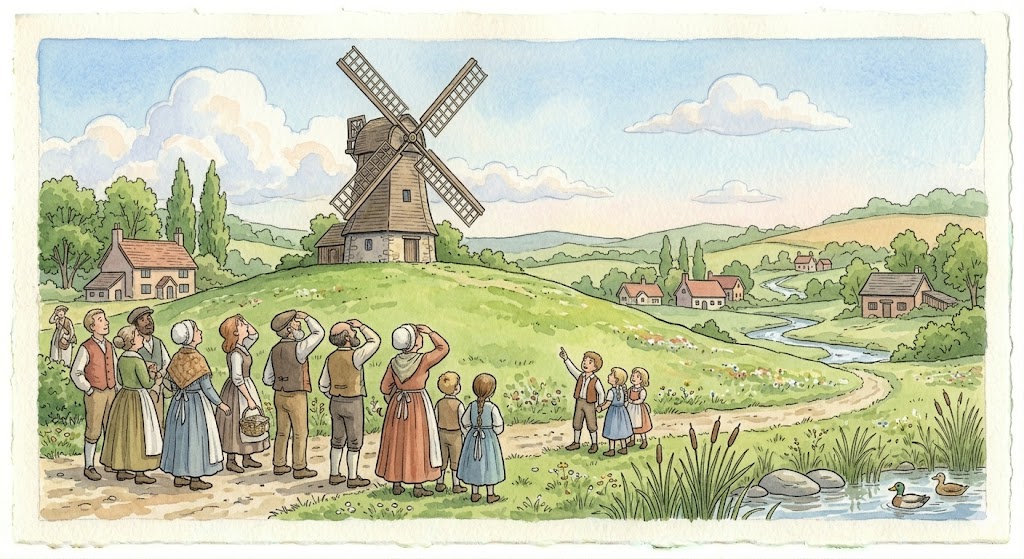
On the hill above the village of Millbrook, there stood a windmill named Clement. He was tall and broad-shouldered, with four great sails that caught the wind from every direction. For twenty years, he had ground the village's wheat into flour — day after day, season after season, without rest and without complaint.
Well. Almost without complaint.
"Did you hear them today?" Clement muttered to the weathervane perched on his cap. The weathervane, an iron rooster named Vick, swiveled east in the breeze.
"Hear who?" Vick asked.
"The villagers. The baker's wife brought three cartloads of grain this morning. Three! And when she left with her flour, do you know what she said?"
"Thank you?"
"She said, 'Same time Thursday.' That's it. Not 'What fine flour, Clement.' Not 'How do you manage such perfect grinding, Clement.' Just — 'Same time Thursday.'"
Vick spun west as the wind shifted. "She did seem in a hurry."
"They're always in a hurry," Clement grumbled. "The blacksmith gets a feast day named after him. The schoolteacher gets an apple every morning. The well got a new stone rim last spring and the mayor made a speech. I grind every grain that feeds this village, and I get 'same time Thursday.'"
"You also get the wind," Vick pointed out. "That's quite nice. I enjoy the wind."
"The wind doesn't clap," Clement said darkly.
That night, Clement made his decision. When the morning breeze came — fresh and strong from the south, perfect grinding weather — he locked his sails. Folded them flat against his sides and refused to turn.
The baker's wife arrived at dawn with her cart. She waited. The wind blew. Clement stood motionless.
"Clement?" she called up. "Are you broken? Shall I fetch the millwright?"
"I am not broken," Clement announced. "I am on strike."
"On strike?"
"I will not grind another kernel until this village recognizes my contribution. I want a feast day. I want a plaque. I want the children to sing a song about me. I want applause."
The baker's wife stared. Then she laughed — not cruelly, but with the bewilderment of someone hearing a river demand to be thanked for being wet.
"You're serious," she said.
"Deadly serious," Clement replied. "No recognition, no flour."
The first day wasn't so bad. The baker had reserves. Bread was slightly stale by afternoon, but no one went hungry. By the third day, however, the flour bins were empty. The baker kneaded the last scraps of dough while a line formed outside her door.
"What's wrong with the mill?" asked Farmer Gooden.
"It wants applause," the baker's wife said flatly.
"It wants what?"
Word spread. A delegation climbed the hill — the mayor, the schoolteacher, old Mrs. Fenwick with her walking stick. They stood before Clement's locked sails and looked up.
"Clement," the mayor began, "we understand you'd like some recognition—"
"A feast day," Clement specified. "A plaque. A song. Applause."
"—and we appreciate your work, truly. But people are going without bread. Children are hungry. Could you perhaps turn while we discuss the details?"
"No," Clement said. "First the applause. Then the flour."
The delegation retreated. On the hill, Clement stood tall and still, his sails locked, the south wind streaming uselessly past him. He felt powerful. He felt important. He felt, for the first time in twenty years, noticed.
But on the fifth day, a small girl climbed the hill alone. Her name was Petra, and she was seven, and she was carrying an empty bowl.
"Mr. Clement?" she called up. "My mum says there's no bread for supper again tonight. She says maybe tomorrow, but she said that yesterday too."
Clement looked down. "I'm sorry, child. But I deserve to be appreciated."
"I appreciate you," Petra said. "I think about you every morning when I eat toast. I say, 'Thank you, wind. Thank you, mill.' In my head. I thought you could hear."
Clement's timbers creaked. "You — you say that?"
"Every morning. Mum taught me. She says the things that keep us alive are the things we forget to thank because they're always there. Like the sun. Like the ground. Like you."
Petra held up her empty bowl. "I'm not asking you to turn. I just wanted you to know that I noticed. I always noticed."
She turned and walked back down the hill, bowl swinging empty at her side.
Clement stood still for a long time after that. The wind tugged at his locked sails, patient as ever. Vick swiveled slowly on his cap.
"Well?" Vick said.
"The things that keep us alive," Clement murmured, "are the things we forget to thank because they're always there."
"Sounds about right," Vick said.
"I wanted to be like the blacksmith. Like the schoolteacher. Noticed and celebrated."
"You wanted to be occasional," Vick said. "But you're essential. Essential things are different. They don't get feast days because every day is already theirs."
Clement considered this. The wind pushed at him again, steady and patient. Below, the village was quiet — too quiet. No smell of baking bread. No children running with rolls in their hands.
Slowly, Clement unlocked his sails. They caught the wind and turned — creaking at first from five days of stillness, then smoothing into their old familiar rhythm. The millstones groaned to life. Grain poured in. Flour poured out.
By evening, the baker had bread in every window. The smell drifted up the hill, warm and golden, and Clement breathed it in.
The mayor never declared a feast day. No one composed a song. But the next morning, when the baker's wife brought her cart, she paused before leaving.
"Thank you, Clement," she said. "Truly."
And Petra, eating her toast below, whispered her quiet thanks to the wind and the mill, the same as every morning. Clement heard it this time. It was enough. It was more than enough.