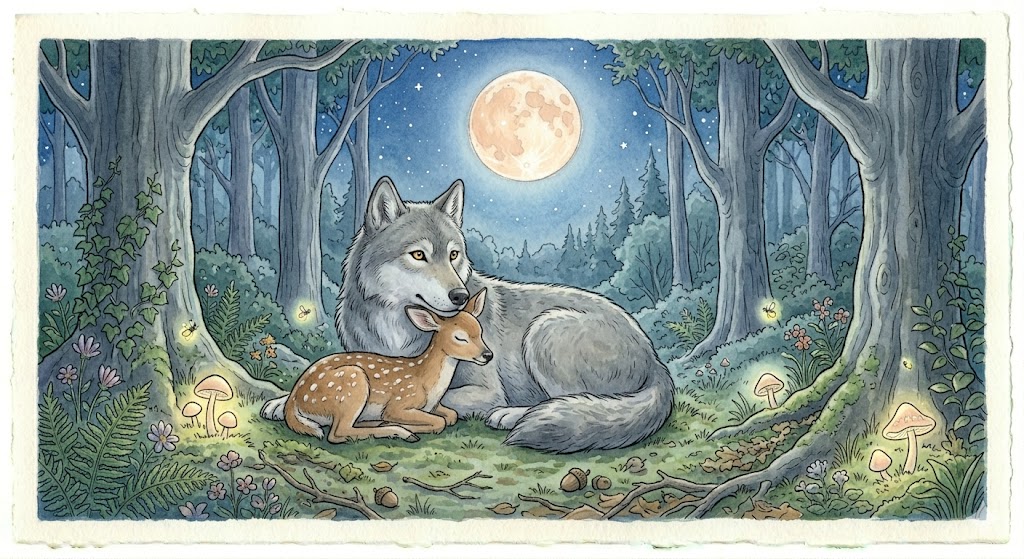
Grey was born with the wrong face for friendship.
He had yellow eyes that glowed in dim light, a jaw that looked like it was built for crunching, and a voice so deep it made the ground hum. When he walked through the forest, silence followed. Birds stopped singing. Rabbits vanished into holes. Even the river seemed to hush itself when Grey came to drink.
He didn't want it to be this way.
"Hello!" he'd call to the squirrels in the morning. But by the time the word left his mouth, the trees were empty and the branches were still swaying from hasty escapes.
"Good evening!" he'd say to the foxes at dusk. They'd freeze, flatten their ears, and slink backward into their dens without blinking.
"I just want to talk," he whispered once to a hedgehog. The hedgehog curled into a ball so tight it rolled down the hill and didn't uncurl until it hit the stream at the bottom.
Grey lived alone in a den beneath an old oak. He ate berries and mushrooms — he'd never once hunted, never even wanted to. His grandfather had been a hunter. His father too. But Grey had looked at a rabbit once when he was young and thought, I'd rather hear its story than end it. His pack had called him strange. Then soft. Then they'd stopped calling him anything at all, and one morning he woke to find they'd moved on without him.
So Grey lived alone. And spoke to no one. And the loneliness grew in him like a vine around a fence post — slow, quiet, tightening.
One autumn evening, Grey was sitting beside the creek, watching leaves float past, when a young deer appeared on the opposite bank. She was small — barely past her spotted stage — with enormous brown eyes and legs that looked like they might snap in a strong wind.
Grey froze. If he moved, she'd bolt. They always bolted.
But the deer didn't bolt. She stood at the water's edge, looking directly at him, her ears swiveling like satellite dishes.
"You're the wolf," she said. Her voice was thin but steady.
"Yes," Grey whispered, barely breathing.
"My mother says I should run from wolves."
"You should," Grey agreed. "Most wolves, you should."
"But you're just sitting there. You were sitting there before I came. If you were hunting, you'd have been hiding."
Grey blinked. No one had ever stayed long enough to observe him. To reason about him.
"What's your name?" she asked.
"Grey."
"I'm Fawn. That's not very original — my mother wasn't feeling creative that spring." She tilted her head. "Why are you sitting alone by the creek?"
"Because no one will sit with me," Grey said. It came out more honest than he intended.
Fawn considered this. The water moved between them, shallow and cold. "Can I ask you something?"
"Anything."
"Do you eat deer?"
"I eat blackberries," Grey said. "And chanterelle mushrooms. And sometimes the wild garlic by the south meadow, though it makes my breath terrible."
Fawn's mouth twitched. Was that — was that a smile?
"A wolf who eats garlic," she said. "My mother would never believe it."
"Most don't," Grey said.
They were quiet for a moment. The creek spoke for them — all burble and murmur and small cold syllables.
"I'll come back tomorrow," Fawn said suddenly. "Same time. If you're here, we can talk more. If you're not, I'll understand."
"I'll be here," Grey said, too quickly, and then felt embarrassed by his eagerness.
She came back. And the next day. And the next. They talked across the creek at first — three feet of water between them like a promise. Grey told her about mushroom seasons, about the way the forest smelled different at each hour, about the old songs his grandmother had hummed. Fawn told him about the herd, about her little brother who was afraid of his own shadow, about the meadow at dawn when the mist made everything look like a dream.
On the seventh day, Fawn crossed the creek.
She stepped carefully on the stones, one hoof at a time, until she stood on Grey's side of the bank. Close enough to touch. Close enough that Grey could hear her heartbeat — fast, but not panicked. Brave.
"You're shaking," Grey said softly.
"A little," Fawn admitted. "Old habits. But I trust you."
"How?" Grey asked. "How can you trust something everyone tells you to fear?"
"Because I listened," Fawn said. "Not to what everyone says about wolves. To what you say. To how you say it. You never once looked at me like food. You looked at me like—"
"Like a friend," Grey finished.
"Yes."
They sat together on the bank, wolf and deer, as the sun dropped low and the forest shifted into its evening colors. A squirrel appeared on a branch above them, stared, and didn't flee. A robin landed nearby, cocked its head, and began to sing.
"Grey?" Fawn said, after a long, comfortable silence.
"Yes?"
"You said no one would sit with you. But I think the problem wasn't just that they ran. I think — maybe — you also stopped trying. You stopped crossing to their side."
Grey thought about this. All those years of calling out and watching others flee — at some point, he'd stopped approaching. Stopped showing up where others gathered. Stopped risking the rejection.
"You're right," he said. "I gave up. I decided the story was written."
"Stories aren't written until someone tells them," Fawn said. "And you need at least two for a conversation."
The next morning, Grey did something he hadn't done in years. He walked to the meadow at dawn — not to the empty edge, but to the middle, where the rabbits gathered for their morning dew. They froze when they saw him. Of course they did. But Grey sat down in the grass, made himself small, and waited.
"Hello," he said. "My name is Grey. I eat mushrooms. I'd like to listen, if you'd like to talk."
It took three days before the first rabbit uncurled enough to answer. But when she did — a small brown rabbit named Dot — she said the same thing Fawn had said on that first evening:
"You're just sitting there."
"Yes," Grey said. "I find that's the best way to start."
Dot twitched her nose. "Start what?"
"A friendship," Grey said. "If you'll have one with a wolf who smells like garlic."
Dot laughed — a tiny, hiccuping sound. And Grey's vine of loneliness loosened, just a little more.